
Summary
The UK ISA regime changed on 6 April 2026, the date on which the Individual Savings Account (Amendment) Regulations 2026 came into force. The reform, signalled at the Mansion House summit in 2025, makes Long-Term Asset Funds (LTAFs) qualifying investments for Stocks & Shares ISAs and Junior ISAs, and removes them from the largely unused Innovative Finance ISA (IFISA) framework. LTAFs held inside an IFISA before that date were grandfathered and reclassified as qualifying holdings for a Stocks & Shares ISA.
Two months on, the retail market is split. Hargreaves Lansdown is the only major direct-to-consumer platform with a live, digitally integrated LTAF proposition inside its Stocks & Shares ISA, SIPP and Fund and Share Account. Most other platforms have declined to onboard the structure, citing regulatory capital costs, dealing-cycle complexity, and a mismatch with how retail clients use the ISA wrapper.
Current platform offerings
Where each major UK retail platform sits at the time of writing:
- •Hargreaves Lansdown — Live. Offers the Schroders Capital Global Private Equity LTAF and the Schroders Capital Global Energy Infrastructure LTAF inside the Stocks & Shares ISA, SIPP and Fund and Share Account. Platform charge capped at 0.35% per annum on the asset-based tier; £1.95 online fund dealing fee. Positioned as a first mover in retail private assets, with a fully digital onboarding and appropriateness journey.
- •AJ Bell — Not offered. Publicly sceptical. Argues that LTAFs create a liquidity mismatch inside an ISA and that closed-ended investment trusts are a better fit for retail private-market exposure.
- •Interactive Investor — Not offered. Cautious observer. Monitoring adviser and self-directed demand and participating in industry distribution working groups.
- •Evelyn Partners (Bestinvest) — Not offered. Maintains that private-market exposure for retail clients is better delivered through listed investment companies.
- •Barclays Smart Investor — Not offered. Named in early distribution and transfer working-group materials but has no consumer-facing product.
- •Nutmeg and Wealthify — Not offered. Robo-adviser model is built around daily-dealing ETFs; LTAF mechanics do not fit the discretionary rebalancing architecture.
Case study: Hargreaves Lansdown's operational architecture
The execution-only proposition at Hargreaves Lansdown is the first end-to-end pipeline for retail investors to deploy capital into private markets through tax-advantaged wrappers. To work around historic minimum-subscription and institutional-only distribution barriers, the platform partnered with Schroders Capital. Retail clients access dedicated feeder funds that pool capital and subscribe into larger, diversified master funds.
Two LTAFs are currently available on the platform.
The Schroders Capital Global Private Equity LTAF uses a Q1 Accumulation share class launched on 30 September 2025. It feeds into the Schroders Capital Semi-Liquid Global Private Equity master fund, an evergreen strategy with approximately $2.9 billion in assets. The master portfolio targets long-term capital growth in excess of 10% per annum after fees, with allocations to small-to-mid buyouts (60–80%), large buyouts (10–30%) and venture or growth capital (0–20%). Geographic exposure is split across North America (40–50%), Europe (40–50%) and Asia (0–20%), with a target 10–20% cash buffer to manage subscriptions and redemptions.
The Schroders Capital Global Energy Infrastructure LTAF uses a Z Accumulation share class launched on 31 March 2025. It feeds into the Schroders Capital Semi-Liquid Global Energy Infrastructure master fund, which holds operational, cash-generating assets supporting the transition to a low-carbon economy. The portfolio targets operational wind parks, solar farms, battery storage and grid infrastructure, with roughly 10–20% reserved for projects under active development or construction.
To meet the FCA's rules for Restricted Mass Market Investments, Hargreaves Lansdown runs a digital onboarding sequence before a trade can be placed:
- •Account. Log in to or open a compatible account — Stocks & Shares ISA, SIPP or Fund and Share Account.
- •Self-certification. Complete an online declaration as either a high-net-worth individual (annual income above £100,000 or net investable assets above £250,000, excluding primary residence and pensions) or a self-certified sophisticated investor. Sophisticated investors are limited to allocating no more than 10% of their investable assets to LTAFs and other high-risk investments.
- •Appropriateness test. Pass an automated online assessment covering illiquidity risk, gating mechanics and performance-fee structures.
- •Order. Confirm the purchase, subject to an initial minimum subscription of £10,000 in cleared cash within the chosen account.
The case for non-adoption
Most UK platforms have so far declined to onboard LTAFs, and the public position from firms like AJ Bell and Evelyn Partners is that the structure is a poor fit for the ISA wrapper rather than a temporary integration problem.
The central argument is the gap between how retail clients use a Stocks & Shares ISA and how an LTAF has to operate. Clients expect to be able to sell holdings, close accounts and transfer wrappers within a few business days. LTAFs use extended dealing cycles to avoid forced asset sales in stressed markets. The Schroders LTAFs on Hargreaves Lansdown, for example, require a 95-calendar-day redemption notice, deal quarterly, allow up to 21 business days after the dealing day for the manager to publish the NAV, and pay out cash approximately 24 business days after the trade date. Once submitted, a redemption request cannot be cancelled.
In practice, an investor asking to withdraw on a September dealing day must submit the request by late June and will not receive cash until early November. Platforms such as AJ Bell argue that placing retail savers into that cycle inside a wrapper they treat as liquid is hard to reconcile with Consumer Duty obligations, particularly if a broader market sell-off coincides with a long notice queue.
The alternative they point to is the closed-ended investment trust. Because trusts trade on a stock exchange, they offer continuous pricing and same-day liquidity, with no notice period. AJ Bell's Head of Investment Analysis, Laith Khalaf, has noted that investment trusts can also use revenue reserves to smooth dividend payments, which is helpful for retirement income — something LTAFs, with their irregular distributions, cannot replicate. Investment trusts also routinely trade at a discount to NAV, giving buyers the option to acquire private-asset exposure below the underlying valuation, whereas LTAFs transact at par NAV.
Operational barriers to platform integration
Beyond the product argument, LTAFs sit awkwardly on the rails most retail platforms run on.
Dealing and settlement. The standard fund order-routing networks used by UK platforms, including Calastone, are built around daily valuation points and short settlement cycles. LTAFs operate on asynchronous cycles — subscriptions typically at T-7 notice with T+22 settlement, redemptions at T-95 notice with T+24 settlement — and require manual administrative handling that adds operational risk and overhead.
ISA transfers. HMRC rules require ISA managers to facilitate the transfer of current-year and previous-year subscriptions on request. If the ISA holds an LTAF, a clean transfer is difficult: the originating platform cannot move the asset inside standard timelines because of the 95-day gate, and the receiving platform may not be willing or able to custody a non-standard, illiquid holding. The practical fallback is either to hold split ISAs across providers — which undermines the simplicity of the wrapper — or to liquidate the LTAF, accepting the dealing delay and any associated cost.
Capital adequacy. Under FCA prudential rules, SIPP and platform operators must hold additional regulatory capital against any non-standard asset they custody. LTAFs are classified as non-standard, so platforms tie up balance-sheet capital to support them, reducing return on equity.
Consumer Duty. Platforms must evidence that the products they host deliver fair value and avoid foreseeable harm. The combination of complexity, potential performance fees, and discretionary redemption charges that an LTAF manager can apply to recover the cost of selling underlying assets is a high evidential bar for a niche product set.
The industry Retail LTAF Distribution Group (RLDG) is working on technology integrations to automate notice periods and gating, but progress has been slow. For now, the retail LTAF market through a Stocks & Shares ISA is likely to remain concentrated on a single platform.
Alternative retail private-asset vehicles
For investors weighing private-market exposure inside a Stocks & Shares ISA, four structures are realistically in scope. The trade-offs sit on liquidity, pricing and cost.
- •Long-Term Asset Funds (LTAFs). Private equity, private debt and direct infrastructure. Monthly or quarterly subscriptions, quarterly redemptions, 90–95 day notice, monthly NAV publication, dealing at par NAV. Manager can apply performance and discretionary redemption fees.
- •Investment trusts (closed-ended). Public equities, private equity, physical property and niche alternative debt. Continuous trading during market hours, no notice, real-time pricing at a premium or discount to NAV. Standard broker commission plus 0.5% stamp duty reserve tax on purchases.
- •Open-ended funds (OEICs). Listed equities, gilts and corporate bonds. Single daily dealing point on forward pricing at underlying NAV, no notice. No performance fees; occasional dilution levies during heavy outflows.
- •Exchange-traded funds (ETFs). Baskets of listed global equities or fixed income. Continuous real-time trading, no notice, market pricing tracking the index. Low ongoing expense ratios plus standard broker commission.
What it means for you
The April 2026 change makes LTAFs legally available inside a Stocks & Shares ISA, but the practical universe in mid-2026 is one platform and two Schroders feeder funds. That has consequences depending on what you actually want from the wrapper.
LTAFs may fit if you have a long investment horizon, can commit at least £10,000 to an illiquid sleeve, are comfortable with quarterly dealing and a 95-day redemption notice, and are happy to keep the holding with Hargreaves Lansdown for the foreseeable future. They give genuine access to private equity and energy-infrastructure strategies that were previously hard to reach without institutional minimums.
LTAFs probably do not fit if you expect to be able to withdraw at short notice, you plan to transfer your ISA between providers in the next few years, you want regular income that resembles a dividend, or you have other ways of accessing private-market exposure — most commonly through listed investment trusts, which give you continuous liquidity and can trade at a discount to NAV.
If the rest of the platform market eventually integrates LTAFs, the calculus may change. For now, the rule has shifted faster than the distribution infrastructure underneath it.
Frequently asked questions
How many LTAFs are currently registered in the UK? The FCA Register lists 42 records when you count both umbrella funds and their underlying sub-funds. An umbrella is an administrative shell that can hold multiple sub-funds; you cannot invest directly in the umbrella. If you count only the investable sub-funds, the number is 29 as of 1 July 2026. The directory counts investable strategies, not legal shells.
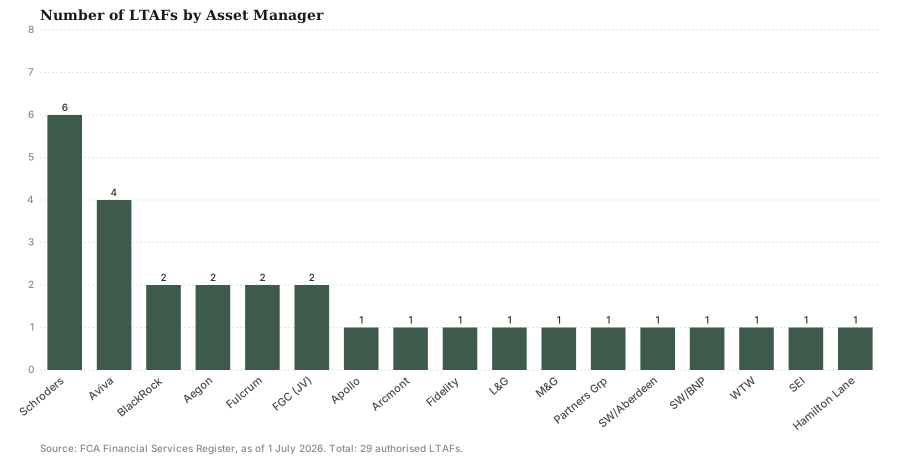
Which asset manager has the most LTAFs? Schroders Capital has the largest authorised LTAF line-up, with six funds on the FCA Register. Aviva (V&G Capital) is second with four. BlackRock, Aegon, Fulcrum and the FGC joint venture each have two.
How many LTAFs are open for private/wealth investors? Only two are available to self-directed retail investors through a mainstream platform as of mid-2026: the Schroders Capital Global Private Equity LTAF and the Schroders Capital Global Energy Infrastructure LTAF, offered via Hargreaves Lansdown inside a Stocks & Shares ISA, SIPP and Fund and Share Account. The rest are currently restricted to institutional investors, pension schemes or professional/sophisticated investors.
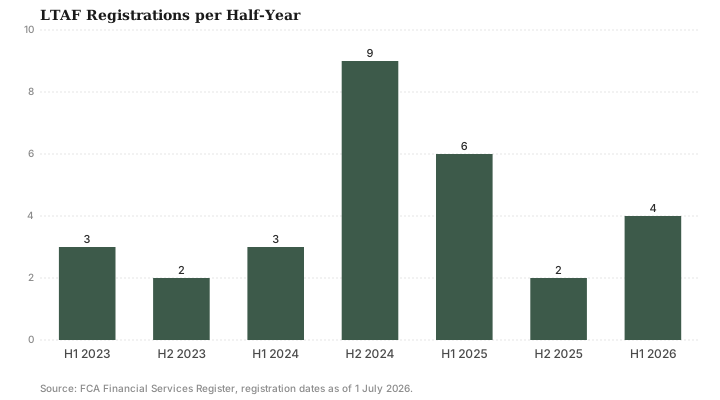
How is the LTAF landscape changing? The rule change has moved faster than the distribution infrastructure. After a burst of registrations in H2 2024, the pace has moderated. The practical market is currently one platform and two funds, with most other platforms citing Consumer Duty, capital adequacy and settlement complexity as reasons not to onboard.
LTAFs by asset manager
Schroders Capital leads the authorised LTAF market with six funds, followed by Aviva with four. The chart below counts sub-funds — the investable strategies that sit inside LTAF umbrellas — as of 1 July 2026.
LTAF registrations by half-year
The second half of 2024 saw a spike in new registrations after the FCA framework settled. The pace has since normalised, with four new registrations in the first half of 2026.
Disclaimer: This article is for information only and does not constitute financial advice. Capital is at risk. Long-Term Asset Funds are illiquid, subject to extended notice periods, and may not be suitable for investors who expect to access their capital at short notice. Tax treatment depends on individual circumstances and may change.
Weekly newsletter
The UK alternative investment market, weekly.
New listings, FCA status changes, and market moves — every week.