
The UK Long-Term Asset Fund (LTAF) is one of the most significant structural innovations in British fund management in recent years. Created by the FCA as a new category of authorised open-ended fund, the LTAF is designed to hold illiquid assets — private equity, private credit, real estate, infrastructure — within a regulated wrapper that aligns redemption terms with the reality of what sits inside.
As of 1 July 2026, there are 29 LTAFs authorised on the FCA's Financial Services Register. The catalogue in this article is pulled directly from that register; no third-party estimates or press-report extrapolations are used.
Two developments have accelerated activity in the last twelve months. First, the Individual Savings Account (Amendment) Regulations 2026, in force from 6 April 2026, made LTAFs qualifying investments for Stocks & Shares ISAs and Junior ISAs, opening the structure to a far wider pool of retail capital. Second, the sponsor base has broadened well beyond the early institutional entrants, with private credit and multi-asset private-markets strategies now dominating new launches.
For the practical implications of the ISA change, see our companion piece: LTAFs in Your ISA After April 2026.
The Regulatory Framework
LTAFs sit within the FCA's existing framework for UK authorised funds. Every UK authorised fund must be established as an Authorised Contractual Scheme (ACS), Authorised Unit Trust (AUT) or Investment Company with Variable Capital (ICVC), and is then categorised by its marketing and investment strategy as a UCITS, NURS, QIS or LTAF.
The LTAF-specific rules are set out in COLL 15 of the FCA Handbook. The key structural features include:
- •Dealing frequency: no more than monthly. This is a hard constraint.
- •Redemption notice: a minimum of 90 days. Investors must give written notice before any withdrawal.
- •Eligible assets: predominantly long-term, illiquid investments.
- •Governance and valuation: enhanced requirements around independent valuation, liquidity stress testing, and disclosure.
The FCA broadened distribution of LTAFs to retail and pension-scheme investors through Policy Statement PS23/7, which classified LTAFs as Restricted Mass Market Investments (RMMI). The April 2026 ISA reform layered wrapper eligibility on top of that framework.
Umbrella vs Sub-Fund — How to Count LTAFs
Before reading the register, it helps to understand what is actually being counted. A UK LTAF is almost never a single standalone entity — it is usually a sub-fund sitting inside an umbrella, and the two are very different things.
An umbrella is a legal shell. It is a single FCA-authorised vehicle — an Authorised Contractual Scheme (ACS), Authorised Unit Trust (AUT) or Investment Company with Variable Capital (ICVC) — that holds no assets and takes no investor money. It exists to house one or more sub-funds under one authorisation.
A sub-fund is what you actually invest in. Each sub-fund is a distinct pool of assets with its own investment strategy, its own NAV, its own share or unit classes, and (in UK structures) segregated liability from the other sub-funds under the same umbrella.
Why managers use this structure. One heavy FCA authorisation process for the umbrella, then adding future sub-funds is a much lighter approval. A recent example: in June 2026, SEI Investments received approval for the CG SEI Global Investment LTAF (the umbrella) and the CG SEI Diversified Private Asset LTAF (its first sub-fund). Investors can only allocate to the sub-fund. The "CG" prefix reflects Carne Global Fund Managers as the authorised fund manager — Carne runs a hosting platform, which is why the same "CG" prefix appears across Apollo, Aegon, Scottish Widows, WTW and SEI structures.
Why published counts diverge. The FCA Financial Services Register lists umbrella shells and their sub-funds as separate entries. Investment Week, reporting the SEI approval, cited "42 LTAFs" currently available to the UK market — that figure double-counts, treating the SEI umbrella and its single sub-fund as two funds, and doing the same across every other multi-fund umbrella on the register. There are not 42 investable LTAF strategies in the UK.
Our methodology aligns with Morningstar and other independent researchers: count investable strategies only — sub-funds plus any standalone LTAFs that are not structured as umbrellas. On that basis the register holds 29 investable LTAFs as of 1 July 2026.
One edge case to watch. The umbrella-to-sub-fund ratio is not 1:1. Schroders Capital, Aviva Investors and the Carne-hosted umbrellas each contain multiple sub-funds, so you cannot simply halve the raw register count to get to an investable number.
The Market at a Glance
Across those 29 investable strategies, aggregate LTAF assets under management stood at approximately £7.3 billion as of Q2 2026, per Morningstar — a level that has roughly doubled year-on-year on the back of the April 2026 ISA reform and expanding DC master-trust allocations.
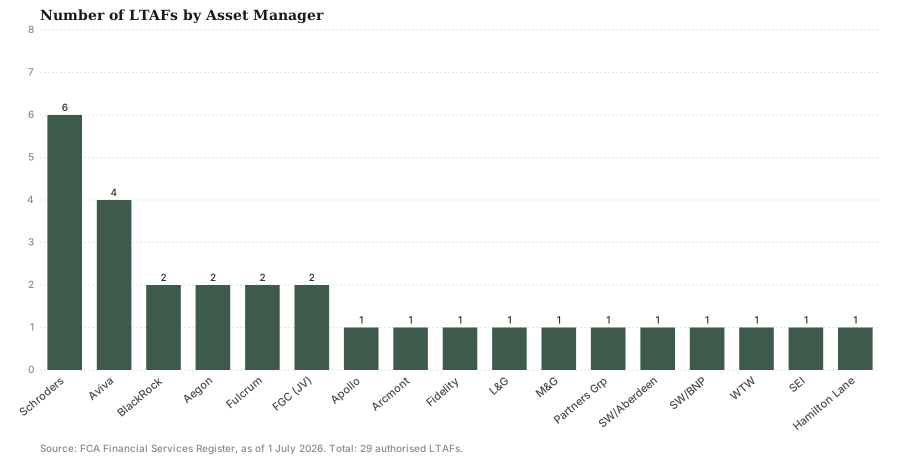
Schroders leads the register with six authorised LTAFs under the Schroders Capital Long-Term Asset Funds umbrella and its wealth-solutions umbrella. Aviva Investors is second with four sub-funds under a single ACS umbrella. The rest of the market is a long tail of one- and two-fund sponsors, with recent 2026 entrants including Apollo, SEI Investments and Hamilton Lane.
Launch Cadence
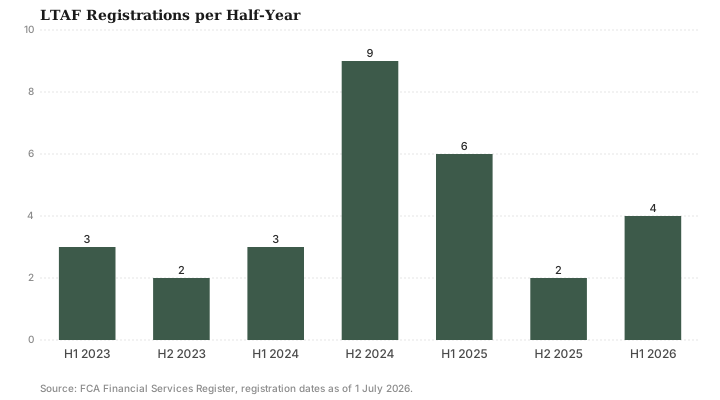
Registration activity has accelerated since the vehicle was introduced in 2021. H2 2024 was the busiest half-year on record with nine new LTAFs registered. Momentum continued into H1 2025 with a further six launches, and H1 2026 has already seen four new entrants — including the first vehicles from Apollo, SEI Investments and Hamilton Lane, and a Schroders/Mercer joint vehicle for master-trust distribution.
The Complete List — All 29 LTAFs
The table below reproduces every LTAF on the FCA Financial Services Register as of 1 July 2026, with operator (AFM), asset manager, umbrella, legal structure, sub-fund, PRN and registration date. Target investor base and core mandate are summarised from each fund's prospectus and manager disclosures.
| # | Operator / AFM | Asset Manager | Umbrella | Structure | Sub-Fund | PRN | Registered | Target Investors | Core Mandate |
|---|---|---|---|---|---|---|---|---|---|
| 1 | Aviva Investors UK Fund Services Ltd | Aviva Investors | Aviva Investors LTAF ACS | ACS (Co-ownership) | Real Estate Active LTAF | 993499 | 17/03/2023 | Aviva UK Life default pensions, institutional plans | Direct commercial property, long-lease real estate |
| 2 | Aviva Investors UK Fund Services Ltd | Aviva Investors | Aviva Investors LTAF ACS | ACS | Climate Transition Real Assets LTAF | 1007650 | 20/12/2023 | Institutional DC defaults, green workplace pensions | Infrastructure, climate transition real assets |
| 3 | Aviva Investors UK Fund Services Ltd | Aviva Investors | Aviva Investors LTAF ACS | ACS | Multi-Sector Private Debt LTAF | 1023327 | 28/11/2024 | Seeded by Aviva My Future Focus default | Private corporate, real estate and infrastructure debt |
| 4 | Aviva Investors UK Fund Services Ltd | Aviva Investors | Aviva Investors LTAF ACS | ACS | Venture & Growth Capital LTAF | 1027160 | 31/01/2025 | Seeded by Aviva UK Life workplace defaults | Unlisted growth enterprises and venture capital |
| 5 | BlackRock (UK AFM) | BlackRock Alternatives | BlackRock Alternative Strategies I LTAF | Co-mingled | Pension Growth Alternative Strategies LTAF | 996362 | 07/11/2024 | BlackRock UK Retirement Savings Plan default | Private equity, infrastructure, real estate |
| 6 | BlackRock (UK AFM) | BlackRock Alternatives | BlackRock Alternative Strategies I LTAF | Co-mingled | Diversified Alternative Strategies LTAF | 996362 | 15/05/2023 | UK DC workplace pension defaults | Infrastructure, private equity, real estate |
| 7 | Carne Global Fund Managers (UK) Ltd | Aegon Asset Management | CG Aegon AM LTAF | ICVC | CG Aegon AM Private Credit LTAF | 1030679 | 12/03/2025 | Aegon UBC default, LifePath default | Senior mid-market corporate lending, fund finance, insured credit |
| 8 | Carne Global Fund Managers (UK) Ltd | Aegon Asset Management | CG Aegon AM LTAF | ICVC | CG Multi-Alternatives Growth LTAF | 1030680 | 12/03/2025 | Aegon UK institutional and wealth | Multi-asset private markets growth |
| 9 | Carne Global Fund Managers (UK) Ltd | Apollo Global Management | CG Apollo Private Markets LTAF | ICVC Sub-Fund | CG Apollo Global Diversified Credit LTAF | 1051500 | 11/02/2026 | UK DC schemes, Aviva My Future Vision default | Investment-grade private and asset-backed finance |
| 10 | Carne Global Fund Managers (UK) Ltd | Arcmont Asset Management (Nuveen) | CG Arcmont LTAF | Open-ended | CG Arcmont Private Credit Europe LTAF | 1015722 | 11/06/2024 | UK DC pension schemes (professional) | European upper-mid-market direct lending |
| 11 | Carne Global Fund Managers (UK) Ltd | Scottish Widows / Aberdeen Investments | CG Scottish Widows LTAF | ICVC Sub-Fund | CG Scottish Widows Diversified Credit LTAF | 1041117 | 20/08/2025 | Scottish Widows workplace members (~4m savers) | Global private markets — PE, infrastructure, real estate |
| 12 | Carne Global Fund Managers (UK) Ltd | Scottish Widows / BNP Paribas | CG Scottish Widows Growth LTAF | ICVC Sub-Fund | CG Scottish Widows Growth LTAF | 1041116 | 20/08/2025 | Scottish Widows workplace default options | Global private credit and corporate debt |
| 13 | Carne Global Fund Managers (UK) Ltd | SEI Investments | CG SEI Global Investment LTAF | ACS Sub-Fund | CG SEI Diversified Private Asset LTAF | 1058533 | 18/06/2026 | SEI institutional client base, pension defaults | Multi-asset private markets, direct lending, infrastructure |
| 14 | Carne Global Fund Managers (UK) Ltd | Willis Towers Watson (WTW) | CG WTW Private Assets LTAF | Open-ended Evergreen | CG WTW Private Equity Access LTAF | 1020373 | 08/10/2024 | WTW LifeSight Master Trust, institutional | Private equity co-investments and direct growth |
| 15 | Fidelity International | Fidelity International | Fidelity Long-Term Asset Funds | Open-ended | Fidelity Diversified Private Assets LTAF | 1017854 | 05/08/2024 | Fidelity FutureWise default strategy | Private credit, equity, infrastructure, real estate, natural resources |
| 16 | Legal & General (Unit Trust Managers) Ltd | LGIM | Legal & General ACS LTAF | ACS Sub-Fund | Legal & General Private Markets LTAF | 1014414 | 15/05/2024 | LGIM workplace defaults, corporate schemes | Diversified private markets, clean energy, infrastructure, credit |
| 17 | M&G Securities Limited | M&G Investments | M&G Long-Term Asset Funds OEIC | ICVC Feeder | M&G Diversified Private Credit Feeder LTAF | 1029812 | 05/03/2025 | UK DC pension plans | Private credit, structured credit, asset-backed debt (feeds Luxembourg RAIF) |
| 18 | Partners Group | Partners Group | Partners Group Long Term Asset Funds | Open-ended | Partners Group Generations Private Credit LTAF | 1026430 | 27/01/2025 | Professional investors, corporate pensions | Global private debt, corporate senior direct lending |
| 19 | Schroder Unit Trusts Ltd | Future Growth Capital (Schroders/Phoenix JV) | Schroders Capital Long-Term Asset Funds | ACS | Schroders (Future Growth Capital) Global Private Assets LTAF | 1020792 | 17/10/2024 | Institutional pensions, global wealth networks | Global PE, VC, infrastructure, private debt |
| 20 | Schroder Unit Trusts Ltd | Future Growth Capital (Schroders/Phoenix JV) | Schroders Capital Long-Term Asset Funds | ACS | Schroders (Future Growth Capital) UK Private Assets LTAF | 1020791 | 17/10/2024 | Phoenix Group defaults, institutional DC | UK PE, VC, real assets, private debt |
| 21 | Schroder Unit Trusts Ltd | Schroders Capital | Schroders Capital Long-Term Asset Funds | ACS | Schroders Capital Climate+ LTAF | 993094 | 09/03/2023 | Institutional DC master trusts, wealth platforms | Climate mitigation, carbon capture, renewables, social infrastructure |
| 22 | Schroder Unit Trusts Ltd | Schroders Greencoat LLP | Schroders Capital Wealth Solutions LTAFs | ICVC / OEIC | Schroders Capital Global Energy Infrastructure LTAF | 1031701 | 31/03/2025 | UK wealth market, HNW retail | Global energy transition infrastructure and real assets |
| 23 | Schroder Unit Trusts Ltd | Schroders Capital Management (Switzerland) AG | Schroders Capital Wealth Solutions LTAFs | ICVC / OEIC | Schroders Capital Global Private Equity LTAF | 1019705 | 23/09/2024 | Wealth segment, Hargreaves Lansdown (SIPP & ISA) | Small/mid-cap buyouts and PE secondaries |
| 24 | Schroder Unit Trusts Ltd | Schroders Capital | Schroders Capital Long-Term Asset Funds | ICVC / OEIC | Schroders Capital UK Innovation LTAF | 1022548 | 14/11/2024 | British Business Bank (LIFTS), Standard Life defaults | Late-stage UK scale-ups, life sciences, deep tech |
| 25 | Schroder Unit Trusts Ltd | Schroders Greencoat LLP | Schroders Capital Long-Term Asset Funds | ICVC / OEIC | Schroders Greencoat Global Renewables+ LTAF | 1006826 | 04/12/2023 | Institutional DC defaults, wealth management | Wind, solar, hydrogen, heat networks, storage (UK/US/Europe) |
| 26 | Schroder Unit Trusts Ltd | Schroders Capital & Mercer | Schroders Capital Long-Term Asset Funds | ICVC / OEIC | Schroders Mercer Private Assets Growth LTAF | 1053795 | 24/03/2026 | Mercer DC Master Trust, Now:Pensions | 50% PE, 25% infra equity, 25% Paris-aligned equities |
| 27 | Waystone Management (UK) Ltd | Fulcrum Asset Management | WS Fulcrum LTAF | OEIC Sub-Fund | WS Fulcrum Diversified Private Markets (H) LTAF | 1011423 | 13/03/2024 | HSBC UK Pension Scheme (bespoke default) | PE, private credit, infrastructure, real estate, timberland |
| 28 | Waystone Management (UK) Ltd | Fulcrum Asset Management | WS Fulcrum LTAF | OEIC Sub-Fund | WS Fulcrum Diversified Private Markets LTAF | 1022445 | 13/11/2024 | Multi-employer pensions, wealth, charities, endowments | Commingled multi-asset via flat-fee open architecture |
| 29 | Waystone Management (UK) Ltd | Hamilton Lane | WS Hamilton Lane Long-Term Asset Fund | OEIC Feeder | WS Hamilton Lane Global Private Assets Feeder LTAF | 1056648 | 15/05/2026 | Wealth platforms, professional and HNW retail | Global private markets co-investments, mid-market direct lending |
The Schroders / Future Growth Capital Duplication Explained
Anyone scanning the FCA register for "Future Growth Capital" will notice what looks like duplicate entries — two funds prefixed Schroders (Future Growth Capital) and two funds prefixed simply Future Growth Capital. They are distinct legal entities on the register, and the duplication reflects a transition in the regulatory operator and the fund umbrella, not a mistake.
Future Growth Capital (FGC) is the private markets joint venture between Schroders and Phoenix Group. Because standing up a new regulatory entity and getting a bespoke umbrella authorised takes time, the rollout was executed in two distinct phases.
Phase 1 — the Schroders umbrella (the "old" PRNs). Operator: Schroder Unit Trusts Limited. Umbrella: Schroders Capital Long-Term Asset Funds (PRN 993093). Sub-funds: Schroders (Future Growth Capital) Global Private Assets LTAF (PRN 1020792) and Schroders (Future Growth Capital) UK Private Assets LTAF (PRN 1020791), both registered 17/10/2024. To get the strategy to market quickly, Schroders initially hosted these FGC-branded strategies as sub-funds under its own pre-existing authorised LTAF platform.
Phase 2 — the dedicated Future Growth Capital umbrella (the "new" PRNs). Operator: Future Growth Capital Limited (FRN 1021597). Umbrella: Future Growth Capital Long-Term Asset Funds (PRN 1053359). Sub-funds: Future Growth Capital Global Private Assets LTAF (PRN 1053361) and Future Growth Capital UK Private Assets LTAF (PRN 1053360), approved 13/03/2026. This is the long-term target operating model: the JV vehicle itself has now achieved its own direct FCA authorisations and set up its own standalone umbrella scheme.
The takeaway: they are distinct legal and regulatory entities on the register because they sit under entirely different corporate operators. The strictly Future Growth Capital-branded funds (without the "Schroders" prefix) represent the mature, dedicated corporate structure of the JV; the Schroders (…) variants were the launchpad versions. The Phase 2 vehicles are shown separately in the register but are not counted in the 29 total above pending confirmation of first NAV strikes; the Phase 1 funds are counted (rows 19–20).
The Pre-Launch Pipeline
Beyond the vehicles currently authorised on the FCA register, a sweep of online filings, legal advisories and industry announcements reveals several prominent LTAF structures currently in structuring or pre-launch.
Aon's dual-LTAF target architecture. Aon, managing approximately £12 billion in UK DC assets (including £5 billion in its master trusts), has designed a dual-LTAF umbrella scheduled for launch in 2026. Rather than deploying a single multi-asset vehicle, Aon is introducing two complementary strategies aligned with different phases of the saver's lifecycle:
- •The Growth LTAF — for younger savers in accumulation. A growth-oriented mix of private equity, infrastructure and real estate, with room for natural capital and forestry. Target net-of-fee returns of 8%–10%.
- •The Retirement LTAF — for savers approaching or in drawdown. Avoids volatile long-duration real estate and infrastructure debt; focuses on short-dated private corporate debt maturing in two to three years to generate stable, yield-bearing cash flow with capital preservation.
Combined, these funds will represent a structural commitment of approximately 15% of Aon's overall default strategy — around £1.5 billion in private markets capital deployment over a three-year phase-in.
Legal & General × Federated Hermes co-structured bespoke LTAF. Following the completion of a major fund merger on 15 August 2025 — which combined L&G and Federated Hermes real estate assets into a £4.7 billion joint UK property fund — the managers announced they are co-structuring a second, bespoke LTAF. The vehicle is designed to accept material inflows from institutional and secondary pipelines, and is specifically structured to deploy capital into long-lease UK commercial real assets and healthcare co-investments.
Morgan Stanley prospective entry. Following the launch of its European Long-Term Investment Fund (ELTIF) targeting continental wealth channels, Morgan Stanley has publicly confirmed it is exploring a dedicated UK LTAF. The vehicle is expected to target the UK private wealth segment, leveraging the April 2026 inclusion of LTAFs within ISA wrappers to reach high-net-worth investors.
What Investors Should Know
Eligibility has broadened but is still gated. LTAFs are Restricted Mass Market Investments. Distribution to retail investors requires appropriateness assessments, and — despite the April 2026 ISA change — only Hargreaves Lansdown currently offers a live, digitally integrated retail proposition. Most exposure still comes through workplace DC pension defaults.
Liquidity is structural, not discretionary. The 90-day notice period and monthly (or quarterly) dealing frequency are regulatory requirements, not manager preferences. Capital committed to an LTAF cannot be retrieved quickly, even in a market downturn — that is by design.
Fee transparency is improving but uneven. Ongoing charges, performance fees and discretionary redemption charges vary widely across the 29 funds, and headline OCFs do not always capture the full cost stack for feeder structures (see the M&G feeder into a Luxembourg RAIF).
The DC pensions market remains the primary audience. The recurring positioning of LTAFs as solutions for DC pension schemes — by BlackRock, Fidelity, M&G, Aegon, Scottish Widows and now Aon — means most individual exposure will continue to come through pension allocations rather than direct investment. For a practical guide to what changes and what does not now that LTAFs qualify for ISAs, see LTAFs in Your ISA After April 2026.
Frequently Asked Questions
How many LTAFs are there?
There are 29 investable LTAF strategies on the FCA Financial Services Register as of 1 July 2026, holding approximately £7.3 billion in aggregate AUM (per Morningstar, Q2 2026).
Some trade press outlets quote a higher figure — Investment Week, for example, cited "42 LTAFs" following the June 2026 approval of the CG SEI Global Investment LTAF — because the FCA Register lists umbrella shells and their sub-funds as separate entries. Umbrellas are legal wrappers that hold no assets; investors can only allocate to sub-funds. Counting sub-funds and standalone LTAFs (the methodology used by Morningstar and other independent researchers) gives 29. See the *Umbrella vs Sub-Fund* section above for the full breakdown.
What asset manager has the most LTAFs?
Schroders leads the register with six authorised LTAFs, spanning private equity, energy infrastructure, renewables, innovation and climate-focused strategies across two umbrella structures.
How many LTAFs are open for Private/Wealth Investors?
Three LTAFs are explicitly structured for wealth and high-net-worth retail channels: the Schroders Capital Global Energy Infrastructure LTAF, the Schroders Capital Global Private Equity LTAF and the WS Hamilton Lane Global Private Assets Feeder LTAF. In practice, only the two Schroders funds are currently available on a live direct-to-consumer platform — Hargreaves Lansdown — inside a Stocks & Shares ISA, SIPP and Fund and Share Account. The Hamilton Lane vehicle is authorised but not yet distributed through a major retail wrapper.
How is the LTAF landscape changing?
The market is shifting on three fronts. Regulatory access — the April 2026 ISA reform made LTAFs qualifying investments for Stocks & Shares ISAs and Junior ISAs, though platform adoption has been slow. Sponsor diversification — the early entrants were largely institutional pension-focused managers, but 2026 has brought new strategies from Apollo (private credit), SEI Investments (multi-asset private markets) and Hamilton Lane (global co-investments). Pipeline depth — several major structures are in pre-launch, including Aon's dual-LTAF default architecture, a co-structured L&G / Federated Hermes real-assets vehicle, and a prospective Morgan Stanley entry targeting UK private wealth.
Further Reading
New Fund Structures for Alternatives: The LTAF and ELTIF
An introduction to the LTAF and ELTIF — two new fund structures designed to broaden access to alternative investments for a wider range of investors.
Read guideLTAFs Explained: The UK's Long-Term Asset Fund for Retail Investors
A complete guide to Long-Term Asset Funds (LTAFs) — structure, liquidity windows, FCA rules, and how UK retail investors access them via SIPPs and platforms.
Read guideDisclaimer: Catalogue sourced from the FCA Financial Services Register as of 1 July 2026. Pre-launch pipeline items are based on public announcements, legal advisories and industry filings; authorisation, structure and timing may change. This article does not constitute financial, legal or investment advice. Always consult the FCA Register directly and seek professional advice before making investment decisions.
Weekly newsletter
The UK alternative investment market, weekly.
New listings, FCA status changes, and market moves — every week.