
Why This Matters for Private Investors
Most writing about angel networks is aimed at founders: how to pitch, how to get in the room, how to close a round. This piece looks through the other end of the telescope. If you are an individual with capital to deploy and an appetite for early-stage risk, angel networks are one of the few structured ways to buy into private companies before the institutions arrive — and to do it with some of the most generous tax reliefs in the developed world sitting underneath.
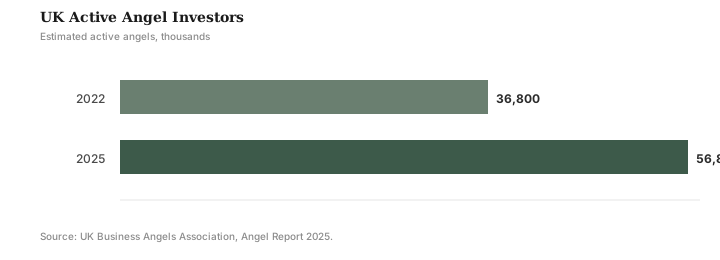
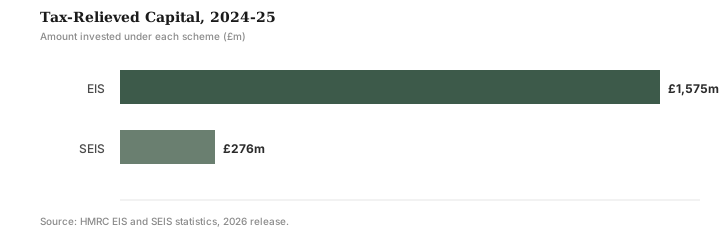
The scale is real. According to the UK Business Angels Association (UKBAA), the trade body for early-stage investment, the estimated number of active angel investors in the UK has grown from 36,800 in 2022 to 56,800 in 2025 — a 54% increase. HMRC's most recent figures show £1.575bn invested through the Enterprise Investment Scheme (EIS) and £276m through the Seed Enterprise Investment Scheme (SEIS) in the 2024–25 tax year. This is no longer a cottage market of lone cheque-writers; it is an asset class with infrastructure.
That infrastructure is what this directory maps. The networks below do three things for a private investor: they source deals you would never see cold, they pool due diligence so you are not underwriting a company alone, and — increasingly — they offer a managed fund so you can get diversified exposure without picking a single company yourself.
The State of the Market in 2026
The UKBAA's Angel Report 2025, published in June 2026, is the most authoritative recent read on the market. Three themes run through it: the investor base is growing and professionalising, capital deployment has become markedly more selective, and organised angel groups — as opposed to lone angels — are doing a disproportionate share of the heavy lifting.
On tax-relieved capital, the picture is one of resilience rather than growth. EIS investment held at £1.575bn, which — in a constrained macro environment — the UKBAA reads as a strong signal. But the number of investors claiming EIS income tax relief fell from 35,675 to 33,220, and the amount on which relief was claimed dropped about 7%. In other words, fewer people are deploying more selectively. SEIS, by contrast, rose to £276m, cementing its role as the entry point for the earliest-stage capital after the 2023 expansion of its limits.
The most interesting data in the report concerns angel groups. Across the 27 groups surveyed, £53m was invested across 321 deals in 2025 — an average of roughly one deal per group per month. But that £53m sat inside total funding rounds worth £348m. Angel groups, in other words, directly supplied about 15% of the capital in the rounds they joined, while anchoring and crowding in the rest. That leverage — the ability of a credible syndicate to pull in co-investors, funds and public money — is the quiet reason joining a network beats going it alone.
Two further shifts matter to anyone deciding whether to join now. First, capital has turned inward: 64% of the groups' 2025 capital went into follow-on rounds for existing portfolio companies, and only 36% into new deals. Second, dealflow is overwhelmingly relationship-driven: 70% of investments came through "warm" channels — referrals and existing networks — versus 30% cold. Warm deals were also bigger, averaging £152,000 against £69,000 for cold-sourced ones.
Where the Tax-Relieved Money Went, 2024–25
For a private investor the read-through is straightforward: SEIS offers the richer 50% income tax relief but only on the very earliest, riskiest companies; EIS is the deeper, more liquid-in-relative-terms pool at 30% relief. Both add capital gains exemption after three years and loss relief if the company fails.
The Two Ways In — Member or Fund
This is the distinction most guides skip, and it is the one that matters most to a private investor. There are two fundamentally different ways to invest alongside a UK angel network, and they suit different people.
Route one — join as an angel and invest deal-by-deal. You apply to the network, self-certify your status, and gain access to its pipeline of pitches. You choose which companies to back and write a cheque into each one directly — your name goes on the cap table, or into a nominee/SPV that holds the shares on your behalf. Tickets typically run £5,000 to £25,000 per deal; the UKBAA puts the average group ticket at about £22,000. You claim your own SEIS/EIS relief. This route gives you control and selection, but demands time, judgement and the stomach to hold concentrated positions.
Route two — subscribe to the network's managed EIS or SEIS fund. Several of the more established networks run a managed fund that invests into the same companies their angels see, but pools your money across a diversified portfolio picked by the manager. Angel Academe's EIS fund, for example, offers exposure to 6–10 companies for a single subscription from £10,000. Par Equity and SFC Capital run comparable structures. You give up deal selection and pay a management charge, but you get instant diversification, professional due diligence and a single set of EIS certificates.
Eligibility — the gate you have to pass. Nearly every network requires you to self-certify as a high-net-worth individual (annual income of £100,000+ or net assets of £250,000+, excluding your main home, pensions and life cover) or a self-certified sophisticated investor. Some set higher bars — Bristol Private Equity Club, for instance, asks for £1m net worth and £200,000 income. These are regulatory requirements, not snobbery: angel investing is classified as high-risk and access is restricted accordingly.
Methodology and Limitations
We've structured this in two layers. First, a set of featured tables covering networks where we could verify current investor economics — ticket sizes, fee structures, access routes — from the network's own materials, published market data, British Business Bank disclosures and financial press. Second, a wider roster of the smaller, regional and thematic groups that make up the rest of the market, named and grouped so you can research each one directly.
Three honest caveats, in the spirit of our LTAF catalogue. First, ticket sizes and fees change and are rarely published in one authoritative place; treat every figure as indicative and confirm with the network before committing. Second, this is a compilation, not a regulated register — groups appear because they are publicly identifiable UK angel networks; inclusion is not endorsement and absence is not a judgement. Third, we've excluded anything that isn't an investable route — deal-flow software, advisory firms and trade bodies — since they don't offer a way to invest alongside.
National Platforms & Marketplaces
These are the widest doors into angel investing: online marketplaces and multi-chapter networks that centralise dealflow nationally. They suit investors who want breadth and a lower barrier to a first deal. Sector focus is generally broad; the trade-off is that curation varies, so due diligence falls more heavily on you.
| Network | Base | Focus | How you invest | Typical investor ticket | Investor cost |
|---|---|---|---|---|---|
| Angel Investment Network | London | Sector-agnostic | Marketplace | Deal-by-deal, from ~£1,000 | Free to browse; deal terms vary |
| Angels Den | London | Sector-agnostic | Lead-angel platform | Alongside a lead, per deal | Platform / SpeedFunding events |
| SyndicateRoom | London | Sector-agnostic | Fund + co-invest | Access EIS fund; deal co-invest | Fund AMC + performance fee |
| Wealth Club | Bristol | Tax-efficient / VCT / EIS | Fund marketplace | HNW; curated EIS/SEIS/VCT | Per-offer charges |
| Envestors | London | Sector-agnostic; SaaS | Members' platform | Deal-by-deal | Regulated platform; success fees |
| SFC Capital | London | Pre-seed / seed | SEIS/EIS fund | Managed fund subscription | Fund fees; upfront commitment |
| 24Haymarket | London | Health, cyber, software | Member + EIS fund | £25k+ typical | ~2% setup, 2% AMC, 20% perf. |
| Cambridge Angels | Cambridge | Deep tech, AI, biotech | Membership (invite-only) | £150k–£1.5m round | Member fees; free to companies |
| Cambridge Capital Group | Cambridge | Golden Triangle deep tech | Membership (~80 members) | £10k single; £150k–£2m syndicated | Membership; deal-by-deal |
| Enterprise 100 (E100) | London | Sector-agnostic | Membership network | Per deal | Membership subscription |
| Newable Ventures | London | MedTech, space, robotics, AI | Syndicated rounds | Per deal | Deal-by-deal |
| Keiretsu Forum London | London / global | Sector-agnostic | Membership chapters | Per deal | Membership subscription |
Regional Syndicates & Co-Investment Funds
Outside London, the story is public-private leverage. Government-backed co-investment funds sit behind regional syndicates and match their capital, so a private investor deploying alongside a regional group is often investing next to public money too. The Regional Angels Programme — run by British Business Investments with a mandate of around £285m, expanded by a further £340m in late 2025 — has made 31 commitments and put £160m into more than 800 companies through partner syndicates. Scotland, Wales and Northern Ireland each add their own co-investment vehicles.
| Network | Base | Focus | How you invest | Typical investor ticket | Investor cost |
|---|---|---|---|---|---|
| Archangels | Edinburgh | Tech & life sciences | Membership (~120 members) | Larger; sector-lead rounds | Annual member fee |
| Par Equity | Edinburgh | Enterprise software, medtech | Angel network + EIS fund | Fund from set subscription | ~3% initial, 1% AMC, 20% perf. |
| Equity Gap | Edinburgh | Sector-agnostic | Membership | £10k+ per deal (indicative) | Matched with Scottish co-invest |
| Kelvin Capital | Glasgow | Software, industrial tech | Membership | £5k–£200k per deal | No annual fee; 10% exit carry |
| Gabriel Investments | Glasgow | Pre-seed / seed | Membership | Per deal | Deal-by-deal |
| Investing Women Angels | Scotland | Female-led (all sectors) | Syndicate | Per deal | Deal-by-deal |
*Verified:* Archangels, founded in 1992 and the UK's oldest continuously operating syndicate, leveraged £41.1m into Scottish scale-ups in 2025 (£12.8m from members, £28.4m co-invested) — up 50% on 2024 — and has invested close to £200m over its life, returning £40m to members in the last four years alone.
| Network | Base | Focus | How you invest | Typical investor ticket | Investor cost |
|---|---|---|---|---|---|
| Angels Invest Wales | Cardiff | Sector-agnostic | Deal-share + co-fund | Alongside £8m Wales co-invest fund | Zero platform fees |
| Women Angels of Wales | Wales | Sector-agnostic (female-led) | Syndicate | From ~£2,000 | Low-barrier entry |
| HBAN (NI) | Belfast | ICT, medtech, food | All-island network | Per deal | Non-profit; zero platform fees |
| GC Angels | Manchester | Tech, digital, creative | Membership (230+ HNW) | Per deal | Publicly backed |
| DSW Ventures | Manchester | Seed EIS (North) | Annual Seed EIS fund | From £10,000 | 7.5% fee on investment, 20% carry |
| NorthInvest | Leeds | Digital & tech | Network | £5k–£1m per deal | 3% success fee (+VAT) |
| Minerva Business Angels | Warwick | Tech, advanced materials | Syndicate (Univ. Warwick) | Per deal | Investor-side largely fee-free |
| Bristol Private Equity Club | Bristol | SEIS/EIS scaleups | Membership (90+) | Deal-by-deal | £1m net worth / £200k income bar |
| Anglia Capital Group | Norwich | Cleantech, agrifood, digital | Membership | Per deal + New Anglia co-invest | Deal-by-deal |
| Dorset Business Angels | Bournemouth | AI, engineering, services | Pitch events | Deal-by-deal | Small event/DD workshop fees |
| S100 Club | Surrey | Tech, spinouts | Investment club | Per deal | Takes no carry or equity |
| FSE Investor Network | Camberley | Sector-agnostic | Network | Per deal | Deal-by-deal |
Sector-Specialist Clubs
These groups organise around a single vertical, where members' domain expertise speeds technical validation. For an investor, a specialist club is a way to concentrate exposure in a theme you understand — climate, defence, deep tech — and to lean on other members' judgement in areas you don't.
| Network | Base | Theme | How you invest | Typical investor ticket | Investor cost |
|---|---|---|---|---|---|
| Green Angel Syndicate | London | Climate & green economy | Membership | From ~£5,000 per deal | ~£624 annual subscription |
| Mint Ventures | Edinburgh | ESG / social / ethical | Membership | Per deal | £650 first year; £400 associate |
| Deepbridge Syndicate | Chester | Tech & life sciences (EIS/SEIS) | Syndicate + EIS/SEIS funds | Fund subscription | Manager fees |
| British Design Fund | UK-wide | Product & design-led hardware | Managed fund | Fund subscription | Fund fees |
| Animal Health Angels | UK-wide | Animal health & veterinary | Syndicate | Per deal | Deal-by-deal |
| AngelClubRCA | London | Design-led (agri/clean/fashion) | Network (RCA) | Per deal | Deal-by-deal |
| CivilizationX | Oxford | Deep tech, AI infra, MLOps, LLMs | Per-deal syndicate | Self-reported wide range | No management fees stated |
Female-Focused & Diversity Networks
A structural shift is under way toward networks that both fund female founders and recruit female investors. For a private investor, these are among the most welcoming entry points — several run explicit education-alongside-investing models and low first tickets — and the underlying thesis has evidence behind it: female-founded teams have historically been underfunded relative to performance.
| Network | Base | Focus | How you invest | Typical investor ticket | Investor cost |
|---|---|---|---|---|---|
| Angel Academe | London | Female-founded tech | Membership or EIS fund | Fund from £10,000; direct from £10k | 5% success fee; fund AMC |
| Alma Angels | London | Female-led tech / IP | Community (no gatekeeping) | £2,000–£400,000 | Zero membership / intro fees |
| Lifted Ventures | Leeds | Regional female-led scaleups | Network (100+ angels) | Per deal | 5% success fee on intros |
| HERmesa | UK-wide | Women-led tech (pre/seed) | Syndicate (RAP-backed) | Per deal | Co-invests with public capital |
| Investing Women Angels | Scotland | Female-led startups | Syndicate | Per deal | Deal-by-deal |
| Gay Investor Network | UK-wide | LGBTQ+ founders & investors | Network | Per deal | Deal-by-deal |
| Diversity X Ventures | UK-wide | Underrepresented founders | Syndicate | Per deal | Deal-by-deal |
| Astia | London / global | Female-led high-growth | Network + events | Per deal | Corporate-partner backed |
*Verified:* Angel Academe — the UK's longest-established female-focused network, founded 2014 — now has 400+ registered angels (70% women), has backed close to 60 companies over 100+ rounds, and runs an EIS fund (from £10,000) alongside £1m of British Business Bank co-investment. It is the clearest single example of a network offering *both* the member route and the fund route under one roof.
The Wider UK Angel Network Map
The featured tables above cover the networks we could describe with verified investor economics. This section widens the lens to the rest of the market — the many smaller, regional, university-linked and thematic groups that make up the UK's angel landscape — grouped by region and theme. We haven't attached ticket sizes or fees here: for most of these groups those figures aren't published in a form we can stand behind.
Golden Triangle — Cambridge, Oxford & Thames Valley. Cambridge Angels · Cambridge Capital Group · Oxford Capital · Oxford Innovation Finance · Oxford Venture Angels · Henley Business Angels · Wren Capital.
London & national syndicates. 24Haymarket Private Capital · Angel Investment Network · SFC Capital · Envestors · Keiretsu Forum London · Deepbridge Syndicate · Enterprise 100 · Found Capital · Advantage Business Angels · Aer Ventures · Aligned Syndicate · Apollo Informal Investment · CAPITALS Circle Group · Korra Ventures · Plerith · Telarik · The Assembly Ventures · Veridian Ventures · Fhunded Angels.
Scotland. Archangels · Par Equity · Equity Gap · Gabriel Investments · Investing Women Angels · Mint Ventures.
Wales & the English regions. Women Angels of Wales · Anglia Capital Group · Minerva Business Angel Network · Gateway Angels (Liverpool City Region) · MAINstream · MAINstream South West · MAINstream Cheltenham · Lincolnshire Business Angels · Angel Investors Bristol · Central Arc Angels · South East Angels · Southern Angel Investors Club · S100 Club · Dorset Business Angels · FSE Investor Network.
University & alumni networks. Harvard Business School Angels · University of Sussex Business Angels · Angels@Essex · Henley Business Angels · Oxford Innovation Finance.
Sector & thematic. Green Angel Syndicate · Mint Ventures · Deepbridge Syndicate · British Design Fund · Animal Health Angels · AngelClubRCA.
Diversity-focused. Alma Angels · Lifted Ventures · HERmesa · Investing Women Angels · Gay Investor Network · Diversity X Ventures.
Online Platforms & Investor Marketplaces
These give you deal access without joining a members' syndicate — from equity crowdfunding to curated deal rooms and tax-efficient fund marketplaces. They suit investors who want to start small, browse widely, or self-serve.
| Platform | Type | What it gives an investor |
|---|---|---|
| Crowdcube | Equity crowdfunding | Direct equity in vetted raises; low minimums |
| Wealth Club | Tax-efficient marketplace | Curated EIS/SEIS/VCT offers for HNWs |
| Floww | Investor platform | Portfolio data + access to managed dealflow |
| Prospedia Capital | Deal marketplace | Curated early-stage opportunities |
| Anchored In | Investor platform | Structured access to vetted deals |
| VenturePath | Investor network platform | Curated pipeline for private investors |
| The Table | Deal room | Members' access to curated rounds |
| ThatRound | Marketplace | Founder–investor matching |
| Fund my Pitch | Marketplace | Open pitch-to-investor listings |
| Master Investor | Media + events | Investor shows and deal exposure |
| Angels@Essex | University platform | FCA-compliant deal room; zero platform fees |
Deliberately left out. A few things get grouped in with angel networks but aren't a way for an individual to invest alongside, so they're not in this directory: deal-flow software sold to networks rather than to investors, corporate-finance advisers, and industry trade bodies. If it doesn't offer you an investable route — a membership, a fund, or a platform — it isn't here.
Five Things the Data Tells Investors
Pulling the UKBAA figures and the directory together, five conclusions stand out for anyone weighing whether — and how — to invest alongside a network.
1. The "warm-deal premium" is exactly what you're buying. 70% of angel-group capital flows through warm channels, and those deals are more than twice the size of cold ones (£152k vs £69k average). As an outsider, you cannot manufacture that dealflow — the network *is* the access. That is the single strongest argument for paying a success fee or fund charge rather than trying to source deals alone.
2. The market has turned toward follow-ons — read the fine print on rights. With 64% of capital now going to existing portfolio companies, a new member joining a mature syndicate is partly buying into its established winners. Ask any network how follow-on allocation works and whether new members get pro-rata rights.
3. Selectivity is the product. Angel groups engaged over 8,000 founders but converted under 2% to investment. That brutal filter — screening hundreds of companies so you see a handful — is most of what your fee pays for. A network that invests in everything it sees is a red flag, not a bargain.
4. Public money quietly leverages your cheque. Between the £285m (+£340m) Regional Angels Programme, Wales's £8m co-fund, and Scotland's co-investment vehicles, private angels investing through accredited partners routinely sit alongside government capital. It doesn't de-risk the company, but it does mean your money helps close larger, better-capitalised rounds.
5. The fee stack varies more than the tickets do. Costs range from flat annual member fees (Archangels), to nothing on the investor side (S100 Club, Alma Angels), to success fees (NorthInvest 3%, Angel Academe 5%), to carry on exit (Kelvin Capital 10%), to full fund charges (Par Equity ~1% AMC + 20% performance). Two investors backing the same company through different routes can pay wildly different all-in costs. Model the fee, not just the cheque.
What Investors Should Know
The tax relief is the backbone of the return. SEIS gives 50% income tax relief on up to £200,000 a year; EIS gives 30% on up to £1m (£2m for knowledge-intensive companies). Both add capital gains exemption after three years and loss relief if the company fails. On a failed SEIS investment, relief plus loss relief can cushion more than 80% of the downside for a higher-rate taxpayer. Relief is only available to UK taxpayers.
Illiquidity is the price of entry. There is no secondary market to speak of. Expect to hold for five to ten years, and to be asked for follow-on capital along the way. Only commit money you can afford to lock up — and lose.
Diversification is not optional. Venture returns follow a power law: a handful of winners carry a portfolio of write-offs. A single angel investment is a coin-flip on ruin; a portfolio of 15–20 is how the asset class is meant to be played. This is the strongest practical case for the fund route if you're starting out.
Do diligence on the network, not just the deal. Who leads? What's the track record on exits, not just deployments? How independent is the due diligence from the people being paid to close the round? A credible lead-investor framework — where an experienced angel sets terms and commits first — is the structural signal that real diligence has happened.
Angel networks are one corner of a much wider alternative-investment map. If you're comparing them against other private-market routes, our venture capital directory and guides on getting started cover the adjacent options — VCTs, EIS/SEIS funds, and the newer LTAF and ELTIF structures.
Frequently Asked Questions
Can a private investor invest alongside an angel network?
Yes. You can either join as an individual angel and invest deal-by-deal (usually after self-certifying as a high-net-worth or sophisticated investor, with tickets from roughly £5,000–£25,000), or subscribe to a network's managed EIS/SEIS fund for a diversified, hands-off portfolio, often from £10,000.
How much money do you need to join a UK angel network?
Most require self-certification as a high-net-worth individual (£100,000+ income or £250,000+ net assets excluding home and pension) or a sophisticated investor. Per-deal tickets commonly run £5,000–£25,000; the average angel-group ticket is about £22,000. Managed funds typically start at £10,000.
What tax relief do angel investors get in the UK?
SEIS: 50% income tax relief on up to £200,000/year. EIS: 30% on up to £1m/year (£2m for knowledge-intensive companies). Both add CGT exemption on the shares after three years and loss relief. Relief is for UK taxpayers only.
Are angel networks a good investment for individuals?
They're high-risk and illiquid — most start-ups fail and capital is tied up for years. Networks reduce (not remove) risk through heavy screening, shared diligence and tax relief. Suitable only for investors who can hold for 5–10 years and afford to lose the capital.
What's the difference between an angel network and an investment club?
In practice the terms overlap. "Network" tends to imply a larger, more structured group with formal pitch events and staff; "club" often means a smaller, member-led group investing on a deal-by-deal basis with minimal fees. Both pool investors around early-stage private companies.
Disclaimer: This article is research and education, not financial, legal or investment advice. It is based on publicly accessible sources — including the UKBAA Angel Report 2025, HMRC's 2026 EIS/SEIS data release, British Business Bank disclosures, and each network's own materials — as of 2 July 2026. Figures for individual networks are indicative, change frequently, and should be confirmed directly with the network before you invest. Inclusion is not endorsement, and absence is not a judgement. Early-stage investing carries a high risk of losing all your capital and is highly illiquid.
Weekly newsletter
The UK alternative investment market, weekly.
New listings, FCA status changes, and market moves — every week.