

Introduction to Private Equity
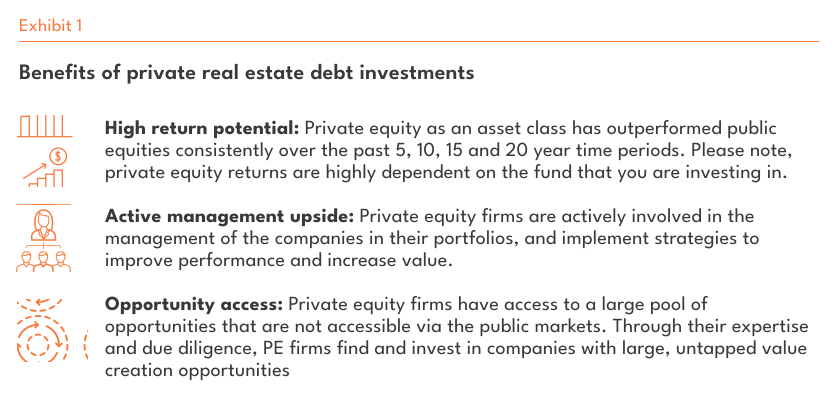
Private equity represents one of the most significant segments of alternative investments. At its core, private equity involves investing directly in private companies—businesses not listed on public stock exchanges. PE firms raise capital from investors, acquire ownership stakes in companies, then work to improve their operations and financial performance before eventually selling them for a profit.
Until the late 20th century, public equity investment dwarfed private equity, but in the past few decades there has been a steady shift towards private markets. Global private equity assets under management reached $8.2 trillion in 2024, growing far faster than public markets. Projections suggest growth to $25.7 trillion by 2029, reflecting enormous institutional appetite for the asset class.
For individual investors, private equity has historically been largely inaccessible—the domain of pension funds, endowments, and ultra-wealthy families. Today, new structures and platforms are opening access, though understanding the landscape remains essential before committing capital.
How Private Equity Works
The Fund Structure
Private equity operates through pooled investment vehicles—funds that aggregate capital from multiple investors. Funds are typically structured as limited partnerships:
General Partner (GP): The fund manager responsible for sourcing, executing, and managing investments. The GP makes all investment decisions and operates portfolio companies.
Limited Partners (LPs): The investors providing capital. LPs have limited liability—their risk is capped at their committed capital—and no say in day-to-day investment decisions. LPs are typically institutional investors such as pension funds, endowments, and sovereign wealth funds, as well as high-net-worth individuals.
Fund Terms: PE funds typically have 10-year lives with possible extensions. The first 3–5 years involve deploying capital (the investment period), followed by a harvesting period focused on value creation and exits.
The Investment Lifecycle
1. Fundraising: The GP raises committed capital from LPs 2. Sourcing: Identifying and evaluating potential investments 3. Due diligence: Comprehensive analysis before acquisition 4. Acquisition: Purchasing the target company 5. Value creation: Operational improvements, strategic initiatives, management changes 6. Exit: Selling the investment via trade sale, IPO, or secondary sale
Capital Calls and Distributions
When you commit to a PE fund, you don't transfer all capital immediately. Instead:
Capital Calls: The GP "calls" capital in instalments as investments are made, typically over 3–5 years. For example, if you commit £50,000, your cash outflow might look like £10,000 paid directly, then eight quarterly calls of £5,000 each over the next two years.
Distributions: As investments are sold, proceeds are distributed back to LPs—typically concentrated in the final 2–3 years of the fund's life.
This creates the "J-curve" effect—returns appear negative initially due to fees and unrealised investments, before improving as holdings mature and are sold.

Private Equity Strategies
Private equity encompasses diverse approaches with varying risk-return profiles:
Buyout The dominant PE strategy, involving acquiring controlling stakes in mature companies. Buyouts are often leveraged—using debt to enhance returns (known as a Leveraged Buyout, or LBO). The strategy involves purchasing a company partly with equity and partly with borrowed cash, improving it operationally, then selling the enhanced business.
Large-Cap Buyout: Acquiring companies valued above $10 billion Mid-Market Buyout: Targeting companies valued $100 million to $1 billion Small-Cap Buyout: Focus on companies under $100 million
Growth Equity Minority investments in established companies seeking capital for expansion. Less risky than venture capital, with proven business models but still significant growth potential. Growth equity investors typically do not use leverage.
Distressed / Turnaround Investing in companies facing financial difficulties. Requires deep operational expertise to restructure balance sheets and return companies to profitability. High risk, but can produce outsized returns.
Sector-Focused Funds specialising in specific industries—healthcare, technology, financial services, industrials. Sector expertise provides sourcing advantages and deeper value-creation capabilities.
Geographic-Focused Funds targeting specific regions—US, Europe, emerging markets. Local knowledge and networks provide deal flow and operational advantages.
Understanding Leverage and Risk
Private equity firms are known for their use of debt to enhance returns. Understanding how leverage works—and the risks it introduces—is fundamental to evaluating the asset class.
How Leveraged Buyouts Work
In a leveraged buyout, the PE firm acquires a company using a mix of equity (their fund's capital) and debt (borrowed money). The debt is typically secured against the acquired company's assets and cash flows. In the optimal scenario, the firm pays off the entire debt during the ownership period using the company's cash flows, and upon sale receives the full proceeds as return on their equity.
The Amplification Effect
Leverage amplifies both gains and losses. If a PE firm buys a company for £100 million using £40 million equity and £60 million debt, and sells it for £150 million after repaying the debt:
- Without leverage: 50% return on £100 million
- With leverage: 125% return on £40 million equity
The Risk Side
Using debt to finance investments increases risk significantly:
- **Interest burden**: Regular interest payments put pressure on portfolio company cash flows
- **Downside amplification**: If the investment underperforms, losses are magnified
- **Refinancing risk**: Debt must be refinanced in changing rate environments
- **Default risk**: If a company cannot service its debt, it may face bankruptcy
The 2022–2023 interest rate cycle demonstrated these risks clearly, as higher rates squeezed leveraged portfolio companies and depressed exit valuations across the industry.
Understanding PE Performance
Private equity performance metrics differ significantly from public market measures:
Internal Rate of Return (IRR) The annualised return accounting for the timing of cash flows. A 20% IRR means capital has grown at 20% annually, adjusted for when capital was called and distributed.
Net IRR: After fees, the return actually received by LPs Gross IRR: Before fees, reflecting raw investment performance
Multiple on Invested Capital (MOIC) Also called Total Value to Paid-In (TVPI). If you invested £100 and received £250, your MOIC is 2.5x.
DPI (Distributions to Paid-In): Realised returns—cash actually paid back RVPI (Residual Value to Paid-In): Unrealised value still in the fund
Public Market Equivalent (PME) Compares PE returns to what would have been achieved investing in public markets with the same cash flow timing. A PME above 1.0 means PE outperformed.
Historical Performance
Over 25 years, private equity has delivered approximately 13.6% annualised net returns, consistently outperforming public equity indices over 5, 10, 15, and 20-year periods. However, dispersion is significant—the top quartile of PE managers returned 21.3% per annum over the 2008–2018 period, while the bottom quartile achieved just 6.7%.
Manager selection matters enormously. The difference between top and bottom quartile PE managers can exceed 15 percentage points annually—far greater than in public markets where most managers cluster around benchmark returns.
Fee Structures and Economics
Private equity fees follow the "2 and 20" model, though terms have evolved:
Management Fee Typically 1.5–2% annually on committed capital during the investment period, then on invested capital thereafter. This covers fund operations, salaries, and deal sourcing. For example, a firm with £1 billion in committed capital and a 2% management fee earns £20 million per year in management fees alone.
Carried Interest ("Carry") The GP's share of profits—typically 20% of gains above a hurdle rate. The hurdle (often 8% preferred return) ensures LPs receive baseline returns before GPs share in profits. This aligns the PE firm's interests with those of its investors.
Other Fees - Transaction fees from portfolio companies - Monitoring fees for board seats - Break-up fees from failed deals
Fee Alignment
Quality managers increasingly offer structures better aligned with LP interests: - Lower management fees on larger commitments - Catch-up provisions capped at 80/20 (GP/LP split) - Crystallisation only on realised gains - Co-investment opportunities at reduced fees
The Impact of Fees
On a fund returning 15% gross IRR, a 2/20 structure might deliver 11–12% net to LPs. Over a 10-year fund life, fees consume a meaningful portion of returns—making manager selection and fee negotiation critical. The price of retail access is even higher: platforms charge an additional layer of fees on top of the underlying fund fees.
How Individual Investors Can Access PE
Traditional PE funds require minimum commitments of £5–10 million, excluding most individuals. However, several routes have emerged to democratise access:
Feeder Funds and Aggregators Platforms pool capital from smaller investors to meet fund minimums. Moonfare, iCapital, and similar platforms offer access with £50,000–100,000 minimums. The platform commits a large sum to the fund, then distributes tickets among retail investors. In addition to providing access, platforms handle due diligence, simplify the investment process, and manage operational complexities like capital calls.
Listed Private Equity Publicly traded vehicles investing in PE: - **PE Investment Trusts**: 3i Group, HgCapital Trust, Pantheon International - **Business Development Companies (BDCs)**: US-listed vehicles offering PE exposure - **Listed PE Fund-of-Funds**: Diversified exposure through a single security
Co-Investment Platforms Some platforms offer direct co-investment alongside established PE firms, often with reduced fees. Requires sophisticated investor status and careful due diligence.
Secondary Market Buying existing LP positions at a discount. Secondary funds and platforms provide access, though complexity is high and discounts typically range from 10–30%.
Evergreen / Open-Ended Structures Newer vehicles without fixed fund lives, offering periodic liquidity. Hamilton Lane, Partners Group, and others offer such structures—providing PE exposure without the traditional 10-year lock-up.
EIS / SEIS Funds UK tax-advantaged funds investing in growth companies. While technically venture or growth focused, some provide PE-like characteristics with significant tax benefits including income tax relief and capital gains exemptions.
Each route involves trade-offs between fees, access, liquidity, and diversification. Your choice depends on capital available, investment horizon, and sophistication level.

Risks and Considerations
Illiquidity PE investments lock capital for 10+ years. Early exits via secondary sales typically involve discounts of 10–30%. Only commit capital you won't need for the foreseeable future.
J-Curve Effect Early years show negative returns due to fees and unrealised holdings. Patience is required—returns typically materialise in years 5–10.
Manager Risk Unlike index funds, PE performance depends heavily on manager skill. Poor manager selection can result in permanent capital loss. The gap between top and bottom quartile is enormous.
Leverage Risk Many buyouts use significant debt. While leverage enhances returns when successful, it amplifies losses and increases bankruptcy risk—particularly in rising rate environments.
Valuation Opacity Private company valuations are estimates, not market prices. Reported NAVs may not reflect realisable value, and there is no daily mark-to-market.
Fee Drag High fees consume substantial returns. A fund returning 15% gross might deliver only 11% net after all fees—and retail platforms add another layer on top.
Commitment Risk Capital calls are obligations. Failing to meet calls can result in forfeiture of prior contributions and legal action. PE funds can call capital at their discretion, often giving just two weeks' notice.
Concentration Risk Individual funds hold 10–20 companies. Poor performance of a few investments can significantly impact overall returns.
Cash Flow Planning The capital call structure means you need to plan cash flows carefully in the early years, ensuring sufficient liquidity to meet calls as they arise.
Understanding these risks is essential before allocating to private equity. The asset class offers compelling return potential but demands patience, due diligence, and appropriate portfolio sizing. If you have those parts covered, private equity investing can be a rewarding long-term experience.