

Introduction to Venture Capital
Venture capital means the provision of private equity to start-up companies and young businesses with strong growth prospects. Most commonly, it refers to investments by venture capital funds, institutions, angel investors, or other private investors. VC investing is usually high risk and aims to identify and invest in the next "Unicorn"—a company valued at over $1 billion.
Despite only around 25% of venture capital investments returning investors' capital, the ones that do succeed generate such high returns that venture is one of the best-performing asset classes in recent history. VC funds have outperformed public equities by nearly 9% over the last 25 years on average.
The global venture capital market surged in 2025, with investment reaching approximately $443 billion—the third-highest annual total on record, according to KPMG. Q4 2025 alone saw $138 billion deployed. AI continues to dominate deal flow, with AI-related companies attracting an outsized share of capital across all stages.
The Case for Investing in Venture Capital
Venture capital investing provides the opportunity to invest in market-leading companies and technologies of the future. In the past, venture has backed some of the biggest successes—from Apple and Google to today's AI leaders—and helped the global economy with much-needed innovation.
The Power Law
Because of the high risk of individual venture capital investments, common strategies focus on investing broadly and aiming for a few big winners. About 20–30% of venture-backed companies go out of business, but 20% end up exceeding a valuation of $250 million. One "Unicorn" investment will usually secure the performance of an entire VC fund.
Approximately 20% of the companies drive 80% of the returns, so access and investment selection are key. This explains why only about half of venture capital funds outperform public markets.
Lower Volatility Than You'd Think
Despite the nature of investing in companies with a high risk of failing, venture investing is not as risky overall as you might think. Over the past 10 years, venture investing has been less volatile than public markets, even during the global financial crisis.
The Arguments Against
The arguments against venture investing include high risk, illiquidity of investments, valuation uncertainty, dilution issues, and the lack of regular income (such as dividends). Investments typically need to be held for at least 5, sometimes up to 10 years.
2025–2026 Market Context
After the sharp correction of 2022–2023, the VC market has entered a new growth cycle. European venture grew in value through 2025 as AI concentration deepened. Key trends for 2026 include stablecoins, robotics, new pathways to liquidity, and continued AI infrastructure investment. The IPO window has also begun to reopen, improving exit prospects.

Understanding VC Funding Stages
Venture capital investments span a company's journey from founding to maturity:
Pre-Seed The earliest stage—often before a product exists. Funding comes from founders, friends and family, and angel investors. Rounds typically range from £50,000 to £500,000.
Seed Product development and initial market testing. Professional VC involvement begins. Rounds typically range from £500,000 to £3 million, valuing companies at £2–10 million.
Series A First significant institutional round. Companies have product-market fit signals and early traction. Rounds of £5–15 million at valuations of £20–50 million are common.
Series B Scaling proven business models. Significant revenue growth demonstrated. Rounds of £15–50 million fund market expansion, team building, and infrastructure.
Series C and Beyond Expansion stage. Companies are often profitable or have clear paths to profitability. Rounds can exceed £100 million, preparing for IPO or strategic acquisition.
Growth/Late Stage Pre-IPO investments in mature private companies. Lower risk than early-stage but also lower return potential. Often involves crossover investors from public markets.
Each stage offers different risk-return profiles. Earlier stages provide higher potential returns but far greater failure rates. Later stages offer more predictable outcomes but compressed returns.
How to Invest in Venture Capital
Up until not long ago, venture investing was reserved for institutions and high-net-worth individuals. Thanks to the boom in crowdfunding and the emergence of tax-beneficial investment schemes, more and more investors have started to invest in start-ups. There are three main ways for an investor to access start-up investing.
1. Angel Investing
Many start-ups allow angel investors to bring in capital and expertise. These investments are often in the form of the tax-efficient SEIS or EIS schemes. Because founders usually limit the number of angels they take on, business angel investments typically start around £10,000 per investment, making it hard for an average investor to diversify effectively. Angels are also often expected to commit personal time and expertise, making it less of a passive investment.
2. Venture Capital Funds
VC funds pool private and institutional capital to buy minority stakes in various start-ups. Investing into a VC fund can be very attractive as on average, they have outperformed public equities by nearly 9% over the last 25 years. However, accessing top-tier funds can prove difficult—many of the best fund managers limit who they partner with.
Minimum investments usually start from £10,000–50,000. Novice investors might access top funds via an existing LP, through co-investment, or through a fund of funds. Investing through VC funds usually incurs management fees and performance fees (carry).
3. Equity Crowdfunding Platforms
Crowdfunding platforms allow everyday investors to make direct investments in start-ups from as little as £10. This low ticket size makes it possible for an average investor to build a diversified portfolio.
Platforms carefully vet which start-ups can raise—often only a small fraction pass screening and due diligence. They list available investment opportunities with pitch decks, financial data, valuations, and progress against funding targets. Fundraising often happens on an all-or-nothing basis: if a campaign doesn't reach its target, all money is refunded.
Key UK platforms include Seedrs and Crowdcube, many offering EIS/SEIS-eligible deals.
Venture Capital Trusts (VCTs)
Listed funds investing in qualifying companies: - 30% income tax relief on investments up to £200,000 - Tax-free dividends and capital gains - Publicly traded with daily liquidity - Professional management and diversification

UK Tax Incentives: EIS and SEIS
The UK government has introduced generous tax reliefs for start-up investors through the SEIS and EIS schemes:
Seed Enterprise Investment Scheme (SEIS)
For very early-stage companies with assets under £350,000: - 50% income tax relief on investments up to £200,000/year - Capital gains exemption if shares held 3+ years - Loss relief against income at marginal rate - CGT reinvestment relief: 50% exemption when reinvesting gains
Enterprise Investment Scheme (EIS)
For qualifying companies with assets under £15 million: - 30% income tax relief on investments up to £1 million/year (£2 million for knowledge-intensive companies) - Capital gains exemption if shares held 3+ years - Loss relief against income at marginal rate - CGT deferral when reinvesting gains
Practical Impact
A higher-rate taxpayer investing £10,000 via EIS: - Immediate £3,000 tax reduction - If investment fails completely, additional loss relief of £2,800 - Effective downside: £4,200 of £10,000 (58% protection) - If investment succeeds: tax-free gains
Important Caveats
Tax relief should never drive investment decisions alone. Only invest amounts you can afford to lose entirely—the tax advantages cushion losses but don't eliminate risk.
Strategies for Successful Venture Investing
A successful strategy of venture investing does not only produce attractive financial returns, but also allows investors to learn about and support technologies they personally believe in—sometimes called "value investing" in the venture context.
Diversification is Key
As with other asset classes, the most important strategy is not to put all eggs in one basket. Building a diverse portfolio of start-ups working on various challenges within several industries increases the chance of investing in at least one winner. A global approach has also proven to benefit returns.
Studies suggest minimum portfolios of 15–20 start-up investments begin to smooth out variance, though even then outcomes depend heavily on access to quality deals.
Selection Matters
A starting point for any investor should be businesses or technologies they understand and believe in. Beyond that, basic research goes a long way. Questions like: - What problem is the company trying to solve? - What is the relevant market size? - What are the barriers to entry? - Does the team have relevant domain expertise?
Focus on the Future
In 2025–2026, venture capital managers are focused on: artificial intelligence and machine learning, autonomous vehicles, robotics, quantum computing, climate tech, gene editing, and cybersecurity. AI in particular has become the dominant theme, attracting the lion's share of capital across all geographies.
Monitor After Investing
Crowdfunding platforms and fund managers provide regular updates after investment. Track your portfolio actively—understanding which companies are progressing helps inform future investment decisions.
Is Venture Capital Right for You?
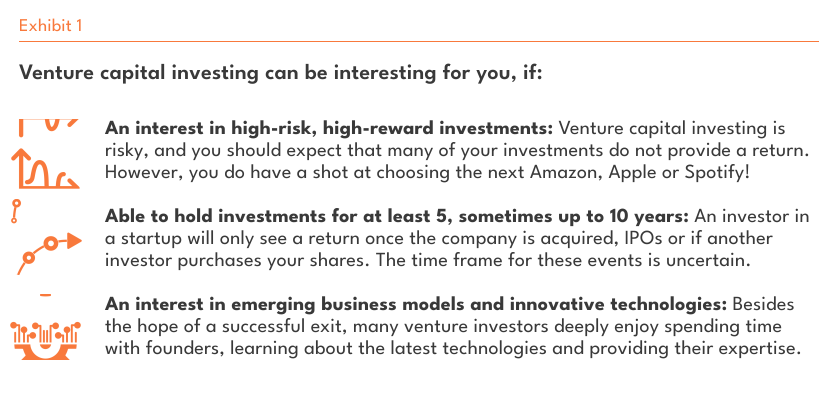
VC Can Be Interesting for You If:
- You are interested in high-risk, high-reward investments
- You are able to hold investments for at least 5, sometimes up to 10 years
- You are interested in emerging business models and innovative technologies
Venture investing is not for everyone, but for the right type of investor, it can be a very lucrative and intellectually rewarding type of investment. Making VC investments, unless placed via a fund, is analogous to placing bets. According to statistics, approximately half of start-ups will go bust within the first three years. Yet a few will become very successful, creating 100% or even 1,000% returns.
Key Risks
Failure Rates: Most start-ups fail. Professional VC funds lose money on 50%+ of investments—individual investors face similar or worse odds.
Illiquidity: Start-up investments are highly illiquid. Exits via acquisition or IPO typically take 7–10 years. Secondary markets exist but with significant discounts.
Valuation Risk: Private company valuations are negotiated estimates, not market prices. The 2022–2023 "down round" environment demonstrated how quickly valuations can compress.
Information Asymmetry: Founders and insiders know far more than external investors. Due diligence is inherently limited.
Dilution: Subsequent funding rounds dilute earlier investors unless pro-rata rights are exercised. A 10% stake can become 2% through multiple rounds.
Winner Selection: Access to the best deals is competitive. Top VCs see thousands of opportunities and invest in dozens. Individual investors see a filtered subset.
Suggested Allocation
VC should represent a small portion of overall portfolio—typically 5–10% maximum of investable assets. Only invest amounts you can afford to lose entirely, and maintain diversification across 15–20+ companies minimum.