
The headline proposal
The FCA wants investors in certain property and other illiquid-asset funds to give at least 90 days' notice before taking money out. Consultation paper CP26/35, published on 8 October 2026, proposes a minimum 90-day redemption notice period for authorised retail funds that invest predominantly in inherently illiquid assets, alongside a limit of no more than one redemption dealing day per month. The regulator's argument is that dealing terms should reflect how long the underlying assets take to sell, giving managers time for orderly disposals and reducing the risk of the suspensions that have hit open-ended property funds when cash ran short.
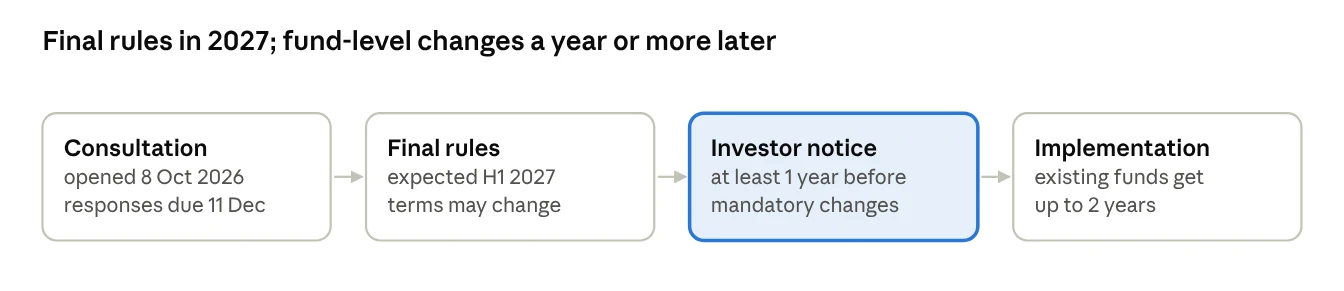
None of this is law yet. It is a consultation, with responses due by 11 December 2026 and final rules expected in the first half of 2027.
Which funds would be affected
The core proposal targets Non-UCITS Retail Schemes (NURS), the authorised fund type behind most UK open-ended property funds. Under the existing test, which the consultation keeps, summarised by Travers Smith, a NURS counts as a fund investing in inherently illiquid assets if its stated policy aims to put at least 50% of the fund into such assets, property and infrastructure among them, or if it has actually held that much in them for three continuous months within the past year. Other NURS could adopt limited redemption arrangements voluntarily, which would ordinarily need unitholder approval.
On scale, the FCA's analysis identifies 17 funds with a combined net asset value of about £7.22bn, a figure also reported by the Financial Times. That is an estimate of the funds in scope, not a measure of anyone's losses.
One distinction matters throughout this piece: LTAFs are not the target. They already operate under a separate framework whose notice period of at least 90 days has been mandatory from the start.
Why daily dealing can be a problem
The mismatch is easiest to see in property. An open-ended property fund can price and deal daily even though selling an office block or a retail park takes months. In calm markets the gap stays invisible, with redemptions met from cash and new subscriptions. When many investors head for the exit at once, the manager has three unattractive options: sell buildings fast, probably at a discount that hurts everyone who stays; run a permanently large cash buffer, which drags on returns because less of the fund is invested in property; or suspend dealing and lock everyone in.
Suspensions have happened at scale. When the FCA last consulted on property fund notice periods, in 2020, AJ Bell counted more than £12.5bn of savings trapped in suspended open-ended property funds. That consultation floated 90 to 180 days' notice; CP26/35 revives the idea with a firmer scope. The FCA's position is that dealing terms should reflect the time it takes to sell the assets, rather than promise liquidity the portfolio cannot deliver.
What 90 days actually means for you
The 90 days measures one thing: the minimum gap between asking for your money and the dealing day on which your units can be sold. Cash comes later than that. An in-scope fund would deal no more than once a month, so the real wait depends on how the notice period lines up with the fund's dealing calendar and its cut-off times, and settlement adds further days after the dealing day. Travers Smith's reading of the consultation makes the same point: investors could wait longer than 90 days in practice.
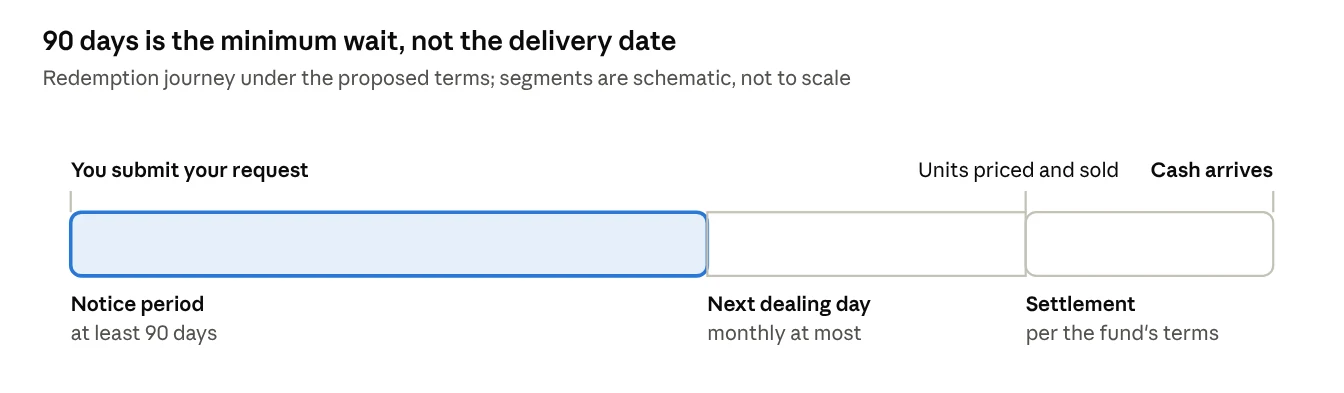
The practical implications are about planning. Money that might be needed for a house deposit, a tax bill or an unexpected expense does not belong in a fund you must ask a quarter in advance. The date you submit a request and the date proceeds arrive are different dates, set by the fund's dealing schedule rather than by your need. And a fund that accepts new subscriptions daily tells you nothing about how quickly it hands money back.
How LTAFs fit into the debate
LTAFs sit on the other side of this consultation. They were built from the start around infrequent dealing and a mandatory notice period of at least 90 days, which is why the proposals treat LTAF units themselves as inherently illiquid assets for the scope test. The Investment Association's October report supports keeping that mandatory notice period but argues its length should be allowed to vary with the liquidity of a fund's underlying strategy, provided investor protection holds, and it wants the FCA to use CP26/35 to reflect on the LTAF's early operating experience.
The consultation does make targeted LTAF changes. Today an accepted LTAF redemption request cannot be withdrawn; the FCA proposes letting investors cancel one during the notice period where the manager is satisfied this would not be unfair to other unitholders, and expects managers to set a cut-off after which a request can no longer be cancelled. The policy debate, in other words, is not simply about making waits longer. It is about matching dealing terms to the assets underneath without hard-coding more rigidity than those assets require.
What happens next
Responses to CP26/35 are due by 11 December 2026, and the FCA expects final rules in the first half of 2027. The transition is deliberately slow: existing funds brought into scope would get up to two years to implement the new arrangements, and investors would have to be given at least a year's notice before a mandatory change to their fund's terms, against the usual 60 days.
For anyone holding an open-ended property fund, a NURS or an LTAF today, the useful move is unglamorous: read the redemption terms you actually have. The proposals will not apply identically across those structures, and the notice period that eventually binds your fund will be set by its own documents, so check those rather than assuming the headline number applies.
The private markets series
- •1. Private markets are opening up to retail investors. Who's buying what?
- •2. £7.3bn in LTAFs, but retail adoption remains a work in progress
- •3. FCA plans 90-day notice period for illiquid funds: what investors need to know (this article)
- •4. Private equity's 19.2-point return gap puts manager selection in focus
- •5. Private markets fund managers plan to raise personal allocations from 12% to 18%
- •6. Investment trusts and alternative investments: why the traditional route is under pressure
Sources
- •FCA, CP26/35: Fair redemption terms for authorised funds investing in illiquid assets, 8 October 2026 (primary source)
- •Travers Smith, "Matching liquidity to reality: FCA proposes new redemption rules for illiquid asset funds (CP26/35)", 13 October 2026 (detail on scope, revocation and transition)
- •IREI, "UK regulator proposes 90-day redemption notice for property funds", 9 October 2026 (the 17 funds / £7.22bn estimate); originally reported by the Financial Times
- •AJ Bell, "FCA proposes notice period for property fund withdrawals", August 2020 (the earlier consultation and suspension context)
- •Investment Association, Private Markets Democratisation in the UK, October 2026 (the industry position on LTAF notice-period flexibility; published at theia.org)
Disclaimer: Nothing here is investment advice. Redemption terms vary fund by fund; check the documents of any fund you hold.
Weekly newsletter
The UK alternative investment market, weekly.
New listings, FCA status changes, and market moves — every week.