
The oldest door into private markets has new competition
For decades the investment trust has been the practical way for a UK private investor to own things that cannot be sold in an afternoon: stakes in private companies, wind farms, loan books, buildings. Listed on the stock exchange, tradable through any broker and generally eligible for ISAs and SIPPs, the structure solves the central problem of illiquid assets, because the trust never has to sell a holding just because a shareholder wants out.
That position is now contested. LTAFs, evergreen funds and large overseas structures offer other ways in, and the argument has moved on from whether trusts can provide access to which structure serves investors best on access, liquidity, cost and governance. This guide covers how trusts work, why the model suits alternatives, what the persistent discounts mean, and where the competition stands.
What an investment trust is
An investment trust is a listed company that pools shareholders' money into a portfolio of assets. Most UK trusts are closed-ended: the pool of capital is fixed, and investors buy and sell shares on the stock exchange rather than redeeming them with the fund. The AIC's guide covers the structure in detail.
The distinction does the heavy lifting. When you sell trust shares, another investor buys them, and the trust itself normally sells nothing and pays out nothing. An open-ended fund, by contrast, issues and cancels units as money comes and goes, so redemptions can force it to sell assets or sit on cash.
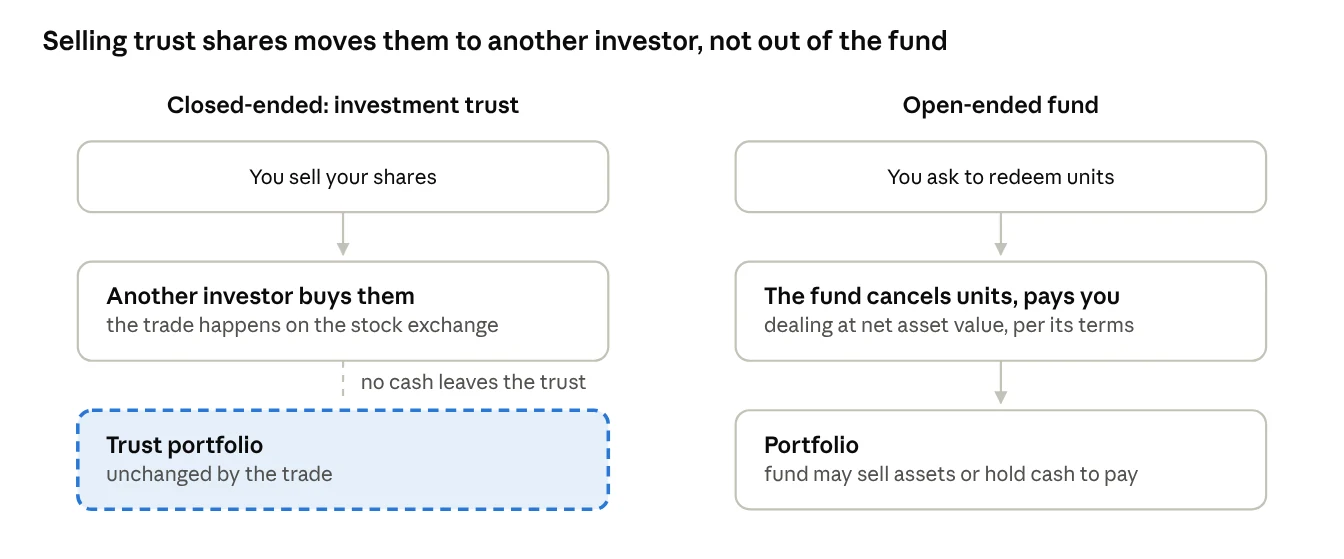
That is why closed-ended vehicles can comfortably hold assets that cannot readily be sold: unlisted companies, decades-long infrastructure projects, specialist property. It is the same liquidity mismatch our FCA notice-period coverage dealt with, solved structurally rather than through dealing restrictions.
What trusts hold, and why the structure suits it
Alternative assets demand patience. A private equity manager may spend years improving a business before selling it; an infrastructure project throws off cash over decades; property takes months to buy or sell. Because trust managers never face individual redemption requests, they can plan around the strategy rather than around exits. Trusts can also borrow (gearing) to increase exposure, which amplifies both gains and losses, and they come with independent boards that can challenge the manager on fees, strategy and capital allocation.
The main categories, and what each actually exposes you to:
| Trust type | What you get | The risks that drive it |
|---|---|---|
| Private equity and growth capital | Stakes in unlisted businesses, directly or via funds of funds | Business performance, leverage, purchase prices, exit markets |
| Infrastructure | Renewables, networks, transport, other essential assets | Interest rates, regulation, financing costs, development risk |
| Private credit | Loans to private businesses and other borrowers | Defaults, recoveries, valuation of hard-to-price loans |
| Real estate (incl. REITs) | Commercial and other property portfolios | Rents, occupancy, valuations, financing costs |
The labels blur in practice: some growth trusts mix listed and private holdings, and not every listed property company is an illiquid-markets vehicle. Two funds filed under "alternatives" can have entirely different return drivers, which is the first thing to check before comparing them.
The discount: opportunity or warning sign
Because trust shares trade on supply and demand, their price can sit above or below the value of the assets inside, a premium or discount to net asset value (NAV). A trust holding £100m of assets across 100m shares has a NAV of £1 a share; at a share price of 80p, you are buying at a 20% discount.
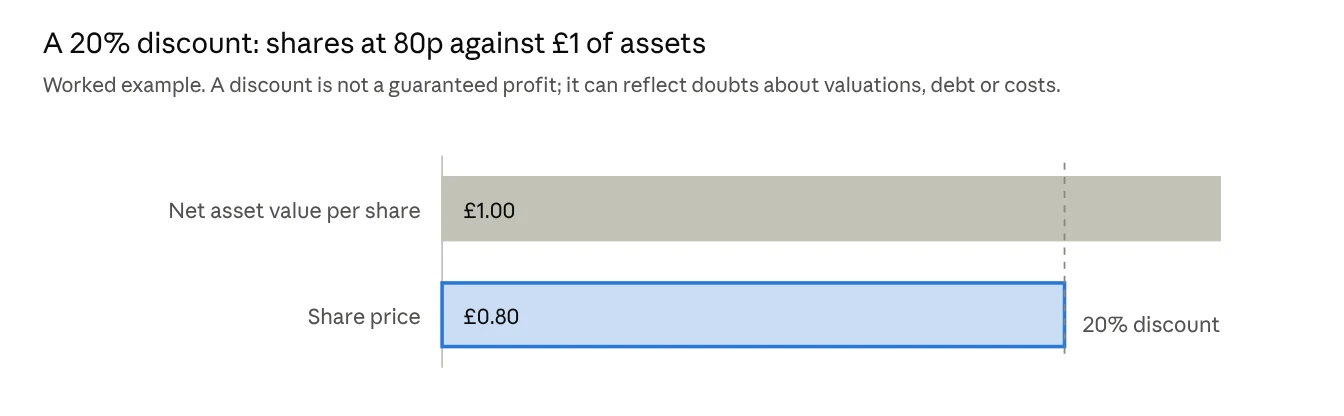
The discounts are real and, in private markets, wide. Sharesify, writing on the AIC's website in July 2026, reported that the average UK trust traded at a 9.6% discount, the narrowest since 2022, while the private equity sector averaged around 26%, with HarbourVest at roughly 22.5% and Pantheon International near 25%; Chrysalis, in the growth capital sector, stood around 44%. Those figures are time-specific and move with markets.
A wide discount asks one question above all: is the reported NAV believable? Private portfolios are revalued infrequently, so the market sometimes prices in doubt. The evidence can cut the other way, though. In the AIC's October release, HarbourVest's managing director Richard Hickman says the trust completed a targeted asset sale in December 2025 at a blended 6% discount to NAV while its shares traded at roughly a 30% discount, which suggests the market was marking the portfolio down far more than buyers of the actual assets were.
Either way, a discount is an entry price, never a promise: it can persist, widen, or turn out to be a fair reflection of debt, costs or stale valuations. Look past the headline number at the portfolio, the reliability of the valuations, the borrowing, the fees and the board's record of returning capital.
The competition, and an industry argument about it
Trusts no longer have the field to themselves. LTAFs were built specifically to hold illiquid assets in a regulated open-ended wrapper, with notice periods matched to the assets, and evergreen funds, often Luxembourg-domiciled, take ongoing subscriptions with periodic redemption windows. The structures trade off differently:
| Investment trust | LTAF | Evergreen fund | |
|---|---|---|---|
| How you exit | Sell shares on the exchange, any trading day | Redeem with the fund; 90 days' notice minimum, dealing typically quarterly | Redeem in periodic windows, subject to limits |
| Price you get | Market price, which can sit well below NAV | NAV-based | NAV-based, per the fund's terms |
| Where the liquidity risk sits | In the share price (discounts, thin trading) | In the wait (notice periods, possible gates) | In the wait (windows, deferrals) |
| Who can buy today | Anyone with a broker; ISA and SIPP eligible | Widening; platform availability still limited | Mostly advised and wealth channels |
The industry is openly arguing about what this means. Responding to the Investment Association's October report, Wealth Club's Jonathan Moyes told Investment Week the trust structure is "losing its place as the go-to vehicle" for private markets. The AIC's own October material makes the opposite case, with director Annabel Brodie-Smith arguing the structure is "perfectly suited to private equity". The IA's report sits somewhere in the middle: it records that many DC, wealth and retail investors now prefer NAV-based vehicles free of listed-market price swings, while noting that trusts have delivered things open-ended structures still struggle with, such as genuinely blended public-private portfolios.
The trust model has not stopped working. It has stopped being the only option, and some leading private markets managers are building their retail offerings in other wrappers first.
The case the trust industry is making: companies stay private for longer
The AIC's counter-argument rests on a structural shift. Businesses are staying privately owned for longer, and some may never list, so a growing share of value creation happens where a public-markets portfolio cannot reach it. Diversified private equity trusts, some holding hundreds or thousands of underlying businesses, give retail investors listed, tradable exposure to exactly that, and the AIC's October commentary leans on realisation evidence to defend the sector's valuations: Pantheon reports exits in the year to May 2026 at a weighted average 18% uplift to holding value, and HgCapital a ten-year average uplift of 29% on exit.
Exposure to private companies still guarantees nothing. Those uplifts are the managers' own reported figures on completed exits, and returns ultimately depend on what was paid for the businesses, the leverage used, the fees charged and whether value can actually be realised through sales or listings in the conditions that arrive.
What to weigh before buying one
The structure alone should never make the decision. Before buying a trust for alternatives exposure, establish what it actually owns and whether it invests directly or through other funds; how diversified the portfolio is; what borrowing it carries; how and how often the NAV is calculated; the full cost stack of fees and expenses; and what the board has done about any persistent discount, from buybacks to asset sales.
Liquidity deserves its own line. Trust shares are usually easier to trade than direct fund interests, and far easier than an LTAF's 90-day notice, but daily tradability has a price of its own: in weak markets you may only be able to sell at a wide discount. Daily dealing in the shares never makes the assets underneath liquid.
For a reader diversifying beyond listed shares and bonds, trusts remain the most accessible established route into private equity, infrastructure and specialist credit, and their combination of permanent capital with exchange-traded shares is still unique. Whether they stay the default route will be decided by how the sector answers the discounts, the costs and the competition. For your own portfolio, the better question is narrower: for the specific exposure you want, which structure's trade-offs, the discount risk of a trust or the waiting risk of an open-ended fund, can you actually live with?
The private markets series
- •1. Private markets are opening up to retail investors. Who's buying what?
- •2. £7.3bn in LTAFs, but retail adoption remains a work in progress
- •3. FCA plans 90-day notice period for illiquid funds: what investors need to know
- •4. Private equity's 19.2-point return gap puts manager selection in focus
- •5. Private markets fund managers plan to raise personal allocations from 12% to 18%
- •6. Investment trusts and alternative investments: why the traditional route is under pressure (this article)
Sources
- •AIC, Your guide to investment companies (structure)
- •Sharesify on the AIC website, "3 UK investment trusts with super wide NAV discounts", 9 July 2026 (sector discount figures)
- •AIC, "Private for longer: the opportunity for private equity investment trusts", 5 October 2026 (the sector's case; realisation figures). The AIC is the trade body for investment companies, so its material argues the sector's side.
- •Investment Week, "Investment trust position as 'go-to vehicle' for private markets questioned after IA report", 15 October 2026 (the Wealth Club comment; paywalled, standfirst only)
- •Investment Association, Private Markets Democratisation in the UK, October 2026 (structure comparison and investor preferences; published at theia.org)
Disclaimer: Nothing here is investment advice. Alternative investments can be illiquid and high risk, investors can lose capital, and a discount to net asset value does not make an investment attractive by itself.
Weekly newsletter
The UK alternative investment market, weekly.
New listings, FCA status changes, and market moves — every week.