
£7.3bn, and still waiting for the retail market
Long Term Asset Funds reached £7.3bn in assets under management at 15 March 2026, up from £5bn in June 2025, with a further £3.1bn committed but not yet called. Two cautions on reading those numbers: committed capital is not money already invested, and the £7.3bn is not retail money. The Investment Association's October 2026 report, like earlier coverage of the same figures, places most of the assets with defined contribution pension schemes and institutional investors.
Who is interested in these funds, and who currently supplies the capital, is covered in Private markets are opening up to retail investors. Who's buying what?. This piece asks a different question: why does a product retail investors are now permitted to buy remain hard to buy in practice? The short answer is that building the funds turned out to be easier than building the machinery to distribute them.
Permission is one thing, availability another
On paper, access has widened step by step. The FCA's policy statement PS23/7, published on 29 June 2023, reclassified LTAF units from non-mass market to restricted mass market investments, extending distribution to mass-market retail investors, self-select DC pension schemes and SIPPs, with risk warnings and appropriateness checks attached. LTAFs entered Innovative Finance ISAs in April 2024. In September 2025 Hargreaves Lansdown added two, becoming the first platform to offer LTAFs in a SIPP, and since 6 April 2026 the funds can be held in stocks and shares ISAs.
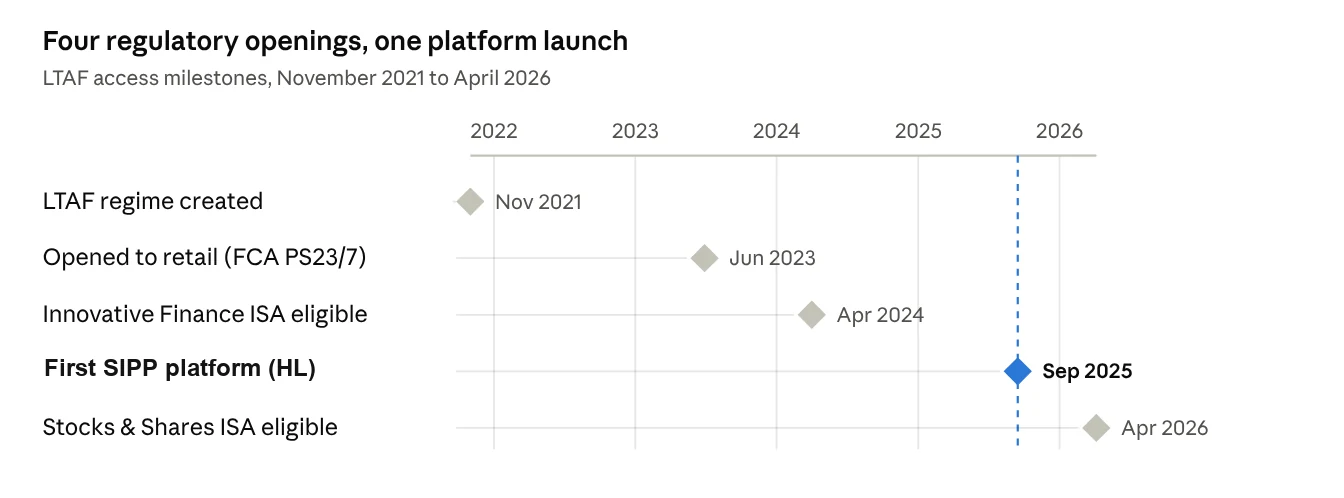
Availability has not kept pace with permission. Morningstar's April 2026 analysis, covered by Pensions Age and Alternative Credit Investor, found roughly 25 strategies on sale, retail uptake still low and platform adoption cautious, with providers waiting for clearer evidence of demand. The IA's October report is best read as the explanation of why that gap persists.
The plumbing problem: platforms were built for daily dealing
The UK's retail investment infrastructure assumes a particular kind of fund: priced daily, dealt daily, settled on a standard cycle, processed straight through. LTAFs break each of those assumptions. Dealing is infrequent, typically quarterly. Redemptions require at least 90 days' notice and can be gated, deferred or managed through side pockets. Settlement varies. Every one of those features has to be carried across platform systems, client reporting and adviser workflows, and through the chain of third parties behind them. Fund administrators, transfer agents and custodians each add their own integration, data-sharing and contract requirements, and where straight-through processing cannot cope, firms fall back on manual workarounds.
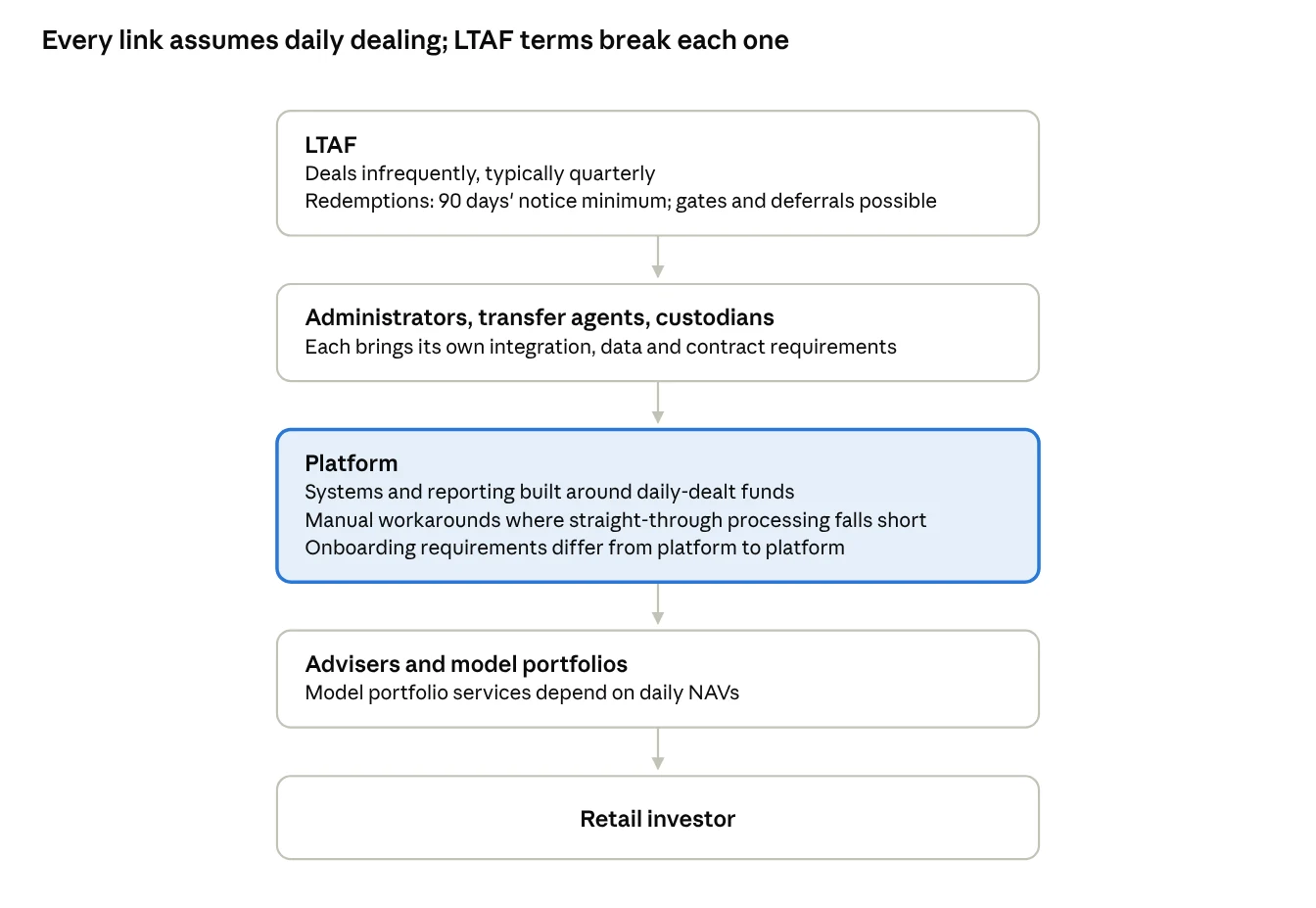
The IA's stakeholder evidence adds a second layer: onboarding requirements differ from platform to platform, which raises the cost of distributing the same fund across the market. Managers told the IA they do not want standardised products, since liquidity profiles genuinely differ between strategies, but they do want standardised operational infrastructure around them.
The commercial consequence is a standoff. Platforms hesitate to invest in new capabilities without clear evidence of demand, while asset managers, advisers and distributors need that infrastructure before their products can reach scale. Each side waits for the other to move first, which is the clearest explanation of why a fund can be authorised, eligible and still absent from the platform most investors use.
The less obvious obstacle: SIPP capital rules
SIPPs look like a natural home for funds that lock money away for years, and a technical rule gets in the way. Under the capital framework for SIPP operators, an asset counts as standard only if it can be realised within 30 days, a test written before the LTAF existed. Because LTAF redemptions require at least 90 days' notice, the funds are classed as non-standard assets, and operators must hold additional capital against client holdings in them. The IA says this can be a factor in some operators' decisions on whether to offer the funds; Morningstar has made the same point, noting that only the more sophisticated SIPP providers are willing to hold that capital.
The IA wants the FCA to amend the relevant rule (Note 1 of IPRU-INV 5.9.1R) so that LTAFs and equivalent recognised overseas funds count as standard assets, in line with their status as authorised funds. That is a request, not a done deal: the FCA has opened the question in its CP26/35 consultation but has changed nothing yet. Stakeholders quoted in the IA report also argue the current label sends an unhelpful signal, implying LTAFs carry more risk than other authorised fund structures.
Even on a willing platform, advisers face another hurdle
Distribution does not end when a fund appears on a platform. An adviser recommending an LTAF has to fit it into advice processes, model portfolios, client reporting, compliance frameworks and rebalancing arrangements, and has to explain notice periods and gating to clients who may read them as defects rather than design choices. Inconsistent reporting across private market products adds to the due diligence burden: the formats and data were never built for large-scale retail distribution, which makes funds harder to compare and to slot into existing systems.
Two further pressures sit on top. Wealth managers increasingly have to justify higher-cost private market allocations against cheap public market funds that have delivered strong returns in recent years. And some pointed the IA to uncertainty over how these products are treated within professional indemnity insurance, which can make advisers reluctant to recommend less familiar funds even where one might suit a client.
What has to change
The IA's recommendations read as a to-do list for the whole chain rather than a request for new products. The asks: standardise the formats that move information between managers, platforms and advisers, covering liquidity disclosures, valuations, redemption processes, operational reporting and onboarding documents; keep building platform capability for non-daily dealing through the Retail LTAF Delivery Group's work; continue adviser and investor education so notice periods and gating are understood as design choices; review the SIPP capital rule; and explore flexibility within the LTAF framework itself, including whether the mandatory notice period could vary in length with the liquidity of the underlying assets, alongside changes to the NURS regime to better support funds mixing public and private assets.
None of it is quick, and all of it needs several parties to move at once. The fair reading of the £7.3bn is that the UK has built working private markets products for pensions and institutions. Building the retail market around them is the unfinished half of the job. An investor who cannot find these funds on their platform today is looking at that unfinished work, not at a gap in their own eligibility.
The private markets series
- •1. Private markets are opening up to retail investors. Who's buying what?
- •2. £7.3bn in LTAFs, but retail adoption remains a work in progress (this article)
- •3. FCA plans 90-day notice period for illiquid funds: what investors need to know
- •4. Private equity's 19.2-point return gap puts manager selection in focus
- •5. Private markets fund managers plan to raise personal allocations from 12% to 18%
- •6. Investment trusts and alternative investments: why the traditional route is under pressure
Sources
- •Investment Association, Private Markets Democratisation in the UK: Promise, Progress and Key Next Steps, October 2026 (primary source; Key Findings 2 and 4–5 and Recommendations 3–5, pp. 4, 9, 12, 15–20; published at theia.org). The IA is the trade body for UK investment managers, so its research reflects an industry perspective.
- •FCA, PS23/7: Broadening retail access to the long-term asset fund, 29 June 2023
- •Pensions Age, "Institutional and wealth sector investment drives LTAF AUM up to £7.3bn", 7 April 2026
- •Alternative Credit Investor, "LTAFs gain ground as retail access to private markets widens", 7 April 2026
- •Morningstar, "What Is a Long-Term Asset Fund?", updated 2025
- •Markets Media, "Schroders, Hargreaves Lansdown Offer Private Funds to Retail", 8 September 2025
Disclaimer: Nothing here is investment advice. LTAFs are illiquid products with notice periods and redemption limits; whether they suit any portfolio depends on individual circumstances.
Weekly newsletter
The UK alternative investment market, weekly.
New listings, FCA status changes, and market moves — every week.