
The people running the funds are buying more of them
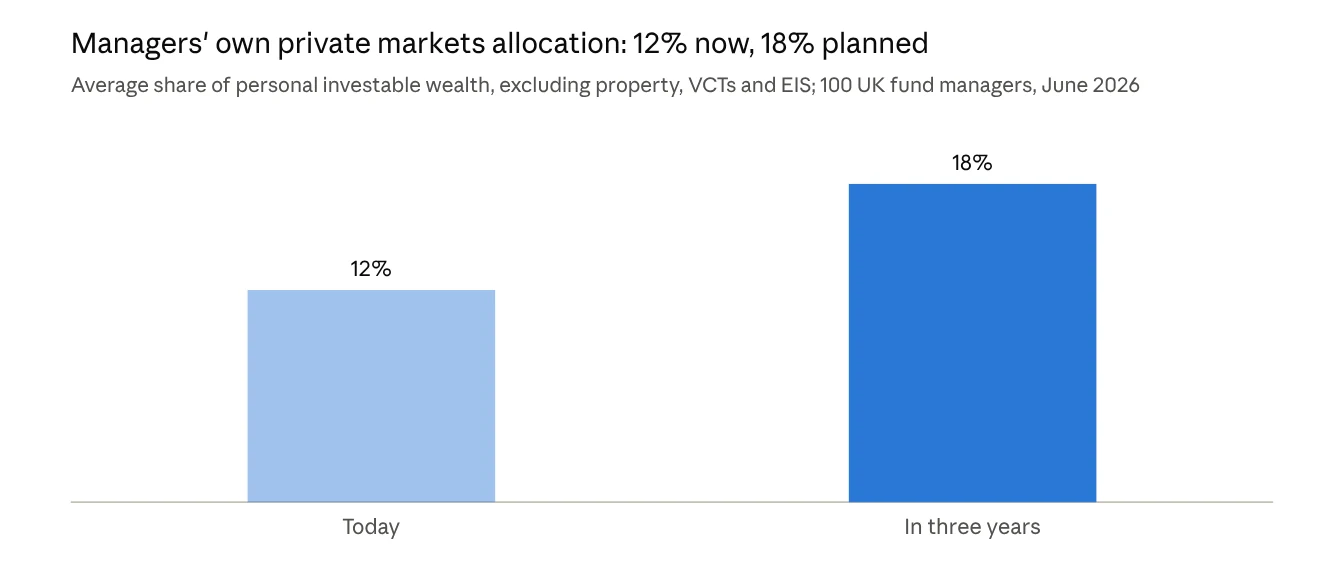
Fund managers working in UK private markets plan to raise the share of their own investable wealth held in the asset class from an average of 12% to 18% within three years, according to Wealth Club research first published in June 2026 and expanded in its October sentiment survey. The research covered 100 UK fund managers across private equity, private credit, real estate and infrastructure, and the allocation figures exclude property, VCTs and EIS. Just 2% currently hold no private markets investments personally, a share they expect to halve to 1%. Alex Davies, Wealth Club's founder and chief executive, called the commitment "a powerful vote of confidence in the long-term prospects of the asset class".
Keep the quote at arm's length, though. The survey records what managers intend to do with their own money. That says something about their conviction, and nothing, by itself, about whether private markets will reward anyone else.
How the professionals get in: evergreen funds near the top
The routes managers use for their own money say a lot about where product design is heading. Per WealthBriefing's coverage of the June survey, 52% primarily use semi-liquid structures, 50% invest directly, more than two in five use traditional closed-ended funds and 26% use listed investment trusts. The categories overlap, since one investor can use several routes.
Semi-liquid, or evergreen, funds take ongoing subscriptions and offer periodic redemption windows, subject to notice periods and limits, rather than raising a fixed pool of capital for a defined fund life. That makes them a more continuous way in than a traditional drawdown fund, and the October survey suggests the structure is where the industry expects growth: 74% of advisers plan to increase their personal private markets investment because of evergreen availability, and 92% of advisers expect evergreen funds to account for at least 5% of client assets within a decade.
The standing caveat from our LTAF coverage applies here unchanged: periodic redemption windows do not make the underlying assets liquid, and an evergreen fund under pressure can still defer or restrict withdrawals.
ISAs and SIPPs feature prominently in managers' plans
Asked how they would want to hold the asset class, the managers pointed overwhelmingly at the wrappers ordinary investors already use. In Wealth Club's survey, 95% said they would probably or definitely invest in private markets through an ISA if suitable investments were available, and 92% said they would probably or definitely do so through a SIPP. That lines up with the regulatory direction covered in our earlier pieces: LTAFs became eligible for stocks and shares ISAs in April 2026, and the FCA's CP26/35 consultation asks whether the SIPP capital treatment of LTAFs should be reviewed.
Two cautions before anyone extrapolates. A wrapper being available does not mean a given fund can be held in it; eligibility depends on the fund's structure and the provider's arrangements, and the ISA answer assumed suitable investments were available. And a tax wrapper changes the tax treatment, never the underlying risk: neither an ISA nor a SIPP removes the possibility of capital losses, notice periods or restricted withdrawals.
Advisers expect the money to follow
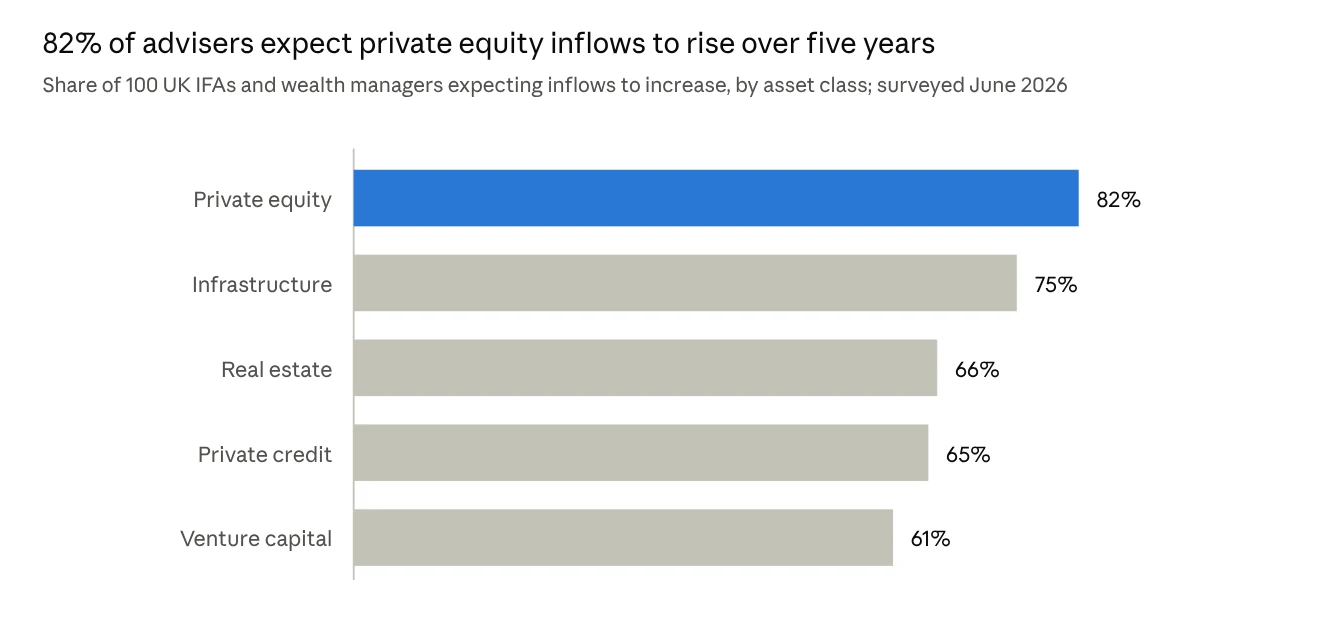
Wealth Club's October follow-up adds the distribution side. Among 100 UK financial advisers and wealth managers surveyed in June, 82% expect inflows into private equity to increase over the next five years, and 53% of those expect the rise to be significant or dramatic. Expectations run high across the asset classes: 75% for infrastructure, 66% for real estate, 65% for private credit and 61% for venture capital.
The route advisers use most today is the listed investment trust, at 57%, though they expect that to drift to 48% within three years while the share using evergreen funds rises from 43% to 48%. Among Wealth Club's own clients, whose average investible wealth is £3.8m where disclosed, 47% already hold private markets investments outside VCT, EIS and SEIS schemes.
A sampling note belongs next to all of this. The research covers 100 managers, 100 advisers and up to 548 Wealth Club clients, and Wealth Club itself notes the results describe those samples rather than the wider UK market.
A signal worth reading carefully, not a performance claim
Managers putting more of their own money into the asset class they run tells you their incentives point the same way as their marketing, and genuine alignment has value. It does not tell you how much of that money goes into their own funds as opposed to private markets generally, whether their personal portfolios have beaten conventional investments, or whether the planned increase will prove profitable. The survey measures intention, and the October research itself records the doubts that sit alongside the enthusiasm: 42% of surveyed investors cite valuation concerns and 40% a lack of transparency, while advisers point to difficulty obtaining underlying performance data, understanding valuation methods and evaluating fees and carry, with complex tax reporting their single biggest obstacle at 39%. Under the Consumer Duty, 77% of advisers say the regime moderately or significantly affects their willingness to recommend private markets.
The risks also differ by asset class: private equity outcomes turn on business performance, leverage and exit valuations; private credit on defaults and recoveries; real estate and infrastructure on their own operating, financing and valuation cycles. And liquidity remains the recurring theme of this series: capital can be committed for years, and a fund offering periodic dealing may still be unable to meet every redemption request under pressure.
For a private investor, the takeaway is the modest one. Professionals expect to hold more of this asset class themselves and want to reach it through ISAs and SIPPs, which tells you where products and access are heading. Whether any particular fund belongs in your portfolio still turns on its strategy, fees, liquidity terms and the job it would do alongside what you already own.
The private markets series
- •1. Private markets are opening up to retail investors. Who's buying what?
- •2. £7.3bn in LTAFs, but retail adoption remains a work in progress
- •3. FCA plans 90-day notice period for illiquid funds: what investors need to know
- •4. Private equity's 19.2-point return gap puts manager selection in focus
- •5. Private markets fund managers plan to raise personal allocations from 12% to 18% (this article)
- •6. Investment trusts and alternative investments: why the traditional route is under pressure
Sources
- •Wealth Club, Private Markets Sentiment Survey, October 2026 (primary source; samples of 100 fund managers and 100 advisers surveyed June 2026, up to 548 Wealth Club clients surveyed July 2026. Wealth Club is an investment platform selling private markets access to high-net-worth investors, so its research reflects a commercial interest in the topic)
- •WealthBriefing, "UK Fund Managers Boost Private Markets Investment", 29 June 2026 (the June manager-survey detail, including access routes)
- •Investment Week, "Private markets managers to increase personal allocations to the asset class", 24 June 2026 (original coverage; paywalled, standfirst figures only)
Disclaimer: Nothing here is investment advice. Private market investments can be illiquid and high risk, and investors can lose some or all of their capital.
Weekly newsletter
The UK alternative investment market, weekly.
New listings, FCA status changes, and market moves — every week.