
A 19.2-point gap between the best and the worst
Pick a mediocre manager in large-cap equities and it costs you a little. Pick one in private equity and it can cost you the case for being there at all. Research from private markets platform Moonfare, published on 15 September 2026, cites an annual return gap between top- and bottom-quartile private equity managers of 19.2 percentage points over 2016–2026, against 2.9 percentage points for large-cap public equities, both figures from J.P. Morgan Asset Management's 2026 Guide to Alternatives.
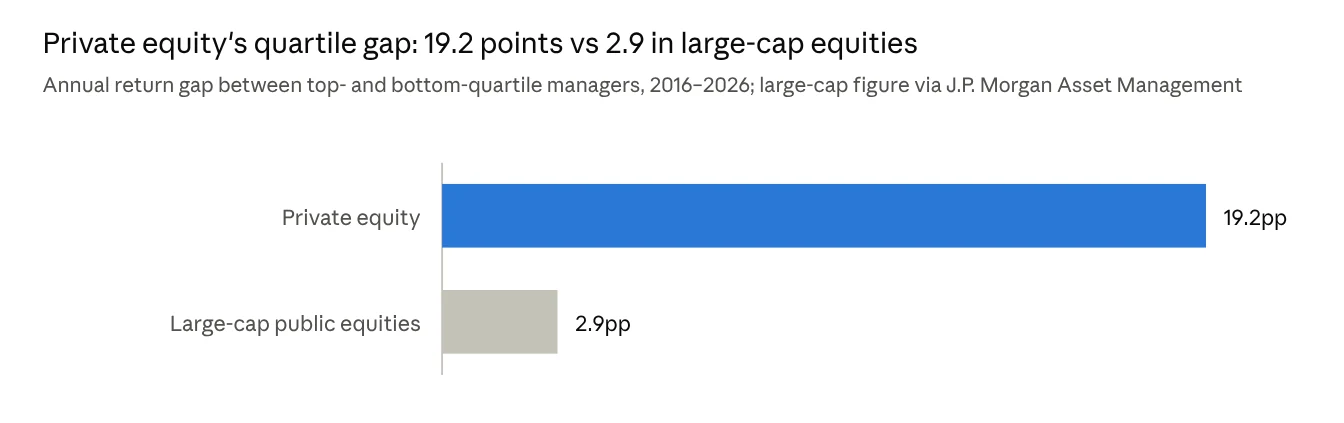
A spread that wide makes manager selection, rather than the decision to allocate to private equity at all, the place where outcomes are made. It is also where the research gets uncomfortable for investors, because the same study suggests that picking the winners in advance is hard.
Why the gap matters: small differences compound
A percentage-point gap sounds abstract until it runs for a decade. Private equity commitments are typically locked up for years, so differences in annual performance compound across the life of a fund. Moonfare illustrates this with a constant-IRR calculation across fund vintages from 2000 to 2023: the ending value implied by top-quartile performance works out at around twice the value implied by median performance over ten years.
That is a modelled illustration, not a forecast, and certainly not a claim that any top-quartile fund will double your money relative to a median one. Real outcomes depend on strategy, vintage, fees, leverage, the timing of capital calls and distributions, and how the underlying businesses actually perform. What the calculation does show is that private equity's headline asset-class return conceals a wide range of individual results, so the question facing an investor is never only whether private equity looks attractive. It is which fund, from which manager, on what terms.
Can investors pick the winners in advance?
The harder question is whether past winners stay winners. Moonfare analysed 647 transitions between successive funds run by the same general partner, restricted to closed-end, finite-life buyout funds. In 34% of cases, a top-quartile fund was followed by another top-quartile fund. Put the other way round, two in three managers whose last fund ranked in the top quartile failed to repeat with the next one.
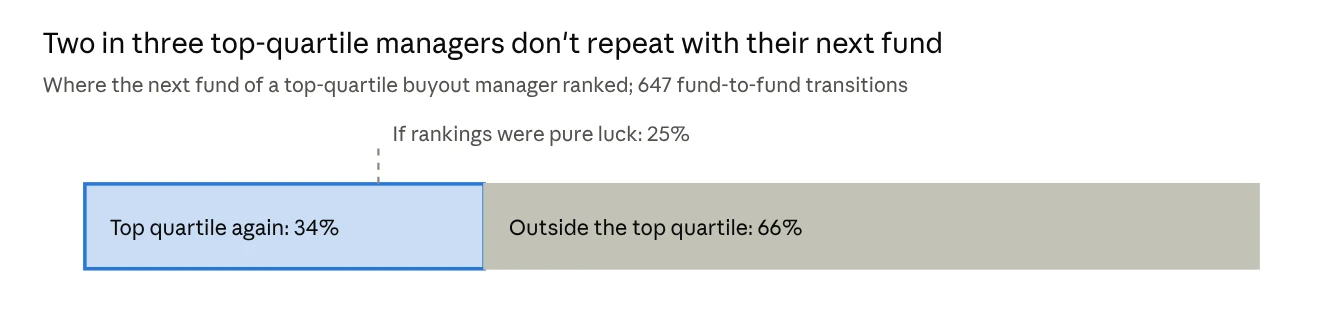
If quartile rankings were pure luck, that repeat rate would sit at 25%, since a quartile holds a quarter of funds by construction. The distance from 25% to 34% says a track record carries some information; the distance from 34% to 100% says it is nowhere near enough to pick a fund on its historical ranking alone. Where persistence does exist, Moonfare attributes it to fixed GP effects: differentiated sourcing, deal pipelines and operational expertise. Steffen Pauls, Moonfare's founder and co-CEO, puts the selection problem bluntly: "A well-known name tells you where a manager has been, not where they are going."
Quartile rankings don't tell the whole story
Even the quartile labels these findings rest on deserve scepticism. PitchBook's manager performance scoring methodology (July 2023) calls quartile placement a blunt measure, because funds within the same quartile can differ widely in absolute return, so two "second-quartile" funds can be very different investments. It also warns that interim IRRs for younger funds are unreliable: early reported figures often bear little relation to the final result, which is why PitchBook only treats a fund's performance as final at age 12.
Dispersion itself also moves around by vintage. In the same document, the gap between median and top-quartile IRR for private equity funds was around 12 percentage points for 2003-vintage funds but only about 4 points for 2006 vintages. A ranking, in short, is a snapshot of one cohort measured at one moment. Investors need to look across several vintages, distinguish realised from unrealised returns, and ask how the returns were generated before treating any league table as a verdict.
Finding a good manager is not the same as getting in
Suppose an investor does the work and identifies a manager with a genuinely repeatable edge. Moonfare's release points to the next obstacle: the strongest funds are structurally oversubscribed, with capacity frequently constrained. The managers most worth backing are often the ones not taking new money on accessible terms. Pauls goes further and forecasts that by the end of the decade capital will have concentrated around a much smaller group of managers with a demonstrated edge, which could make fundraising longer and harder for the rest; that is his prediction, not a finding of the study.
For a private investor, selection and access therefore come bundled. The realistic choice set is the managers available through a given platform or adviser, at the minimum ticket required, at the fees charged, with whatever diversification is on offer. Spreading commitments across managers and vintages reduces dependence on any single fund's outcome, though it cannot remove market risk, and running several funds adds cost and may be impractical on limited capital.
What private investors should take from it
The research makes a case for treating manager due diligence as the centre of private equity investing rather than a final check after deciding to allocate. The questions that follow from it: how has the manager performed across different market conditions and vintages, how much of the reported performance has actually been realised, did returns lean on leverage or on valuation marks, and what has changed in the team, the strategy or the opportunity set since the funds that built the record. Fees belong on that list too, since strong gross performance does not automatically survive management fees, carried interest and other costs on the way to the investor.
Two caveats close the case. Moonfare sells access to private markets funds, so research from it that concludes manager selection is both vital and difficult sits comfortably beside its business model; weigh its findings alongside independent data such as PitchBook's. And the deeper lesson cuts against the marketing of the whole asset class: private equity has no single return. Yesterday's winners are identifiable, cheaply and instantly. Tomorrow's are the expensive part.
The private markets series
- •1. Private markets are opening up to retail investors. Who's buying what?
- •2. £7.3bn in LTAFs, but retail adoption remains a work in progress
- •3. FCA plans 90-day notice period for illiquid funds: what investors need to know
- •4. Private equity's 19.2-point return gap puts manager selection in focus (this article)
- •5. Private markets fund managers plan to raise personal allocations from 12% to 18%
- •6. Investment trusts and alternative investments: why the traditional route is under pressure
Sources
- •Moonfare, Dispersion in Private Markets, 15 September 2026 (primary source; Moonfare is a private markets investment platform, so its research reflects a commercial interest in the topic)
- •PitchBook, Manager Performance Scoring methodology (quartile limitations; vintage-level dispersion figures)
- •J.P. Morgan Asset Management, Guide to Alternatives 2026 (the 19.2-point and 2.9-point dispersion figures, as cited by Moonfare)
Secondary coverage of the study is thin so far; the figures above were verified directly against Moonfare's release.
Disclaimer: Nothing here is investment advice. Past performance is not a reliable indicator of future results. Private equity investments are illiquid and investors can lose capital.
Weekly newsletter
The UK alternative investment market, weekly.
New listings, FCA status changes, and market moves — every week.