
A growing market, an uncertain audience
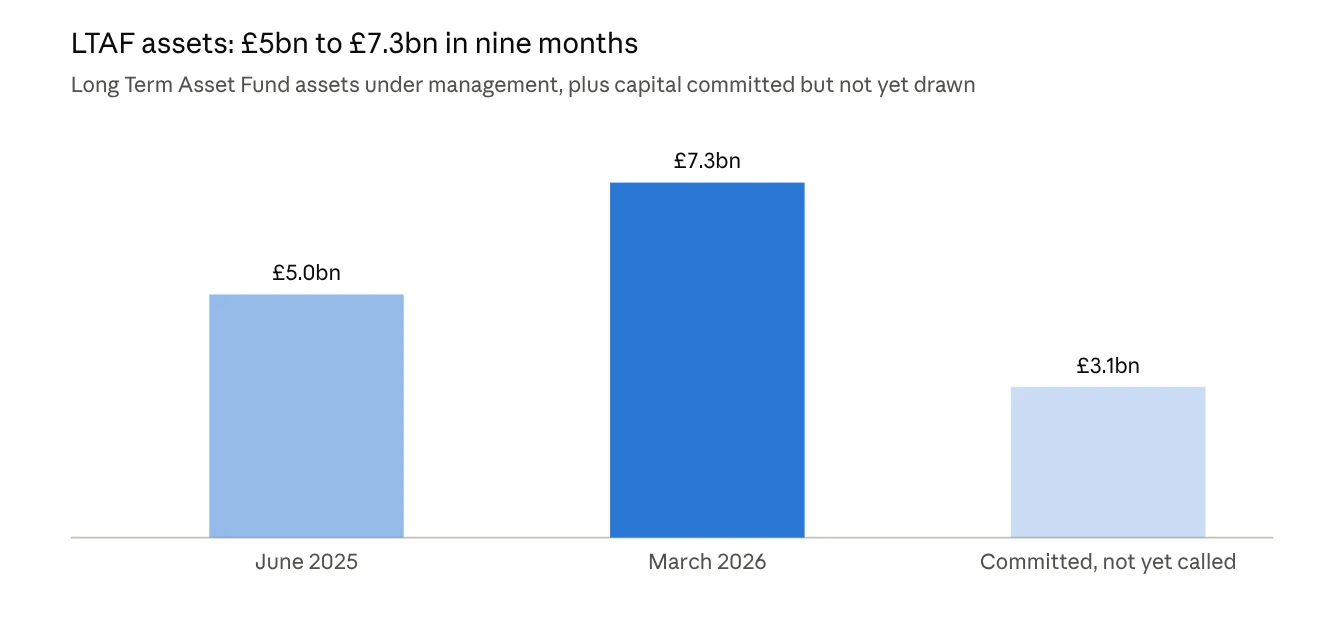
Growth in the vehicle does not mean retail money is flooding in. The IA notes that LTAF assets are currently dominated by DC pension schemes and institutional investors, and its own consumer research found overall willingness to consider the product fell between 2025 and 2026. Underneath the headline sits a more useful question: who is supplying the capital today, and how much demand exists beyond pensions and the wealthy?
Who is interested: the generational divide
The IA's consumer research starts from a low base of familiarity. 41% of investors have heard of an LTAF, and 5% say they know exactly what one is. To test appetite despite that gap, the research gave respondents a full explanation of the product before asking whether they would consider investing.
On that basis, 49% said in 2026 that they would consider an LTAF, down from 57% in 2025. The fall was not evenly spread. Gen Z was the only generation to become keener year on year, up 11 percentage points to 81%. Consideration eased among Millennials, still a majority at 71%, and sits far lower for Gen X (48%) and Baby Boomers (32%).
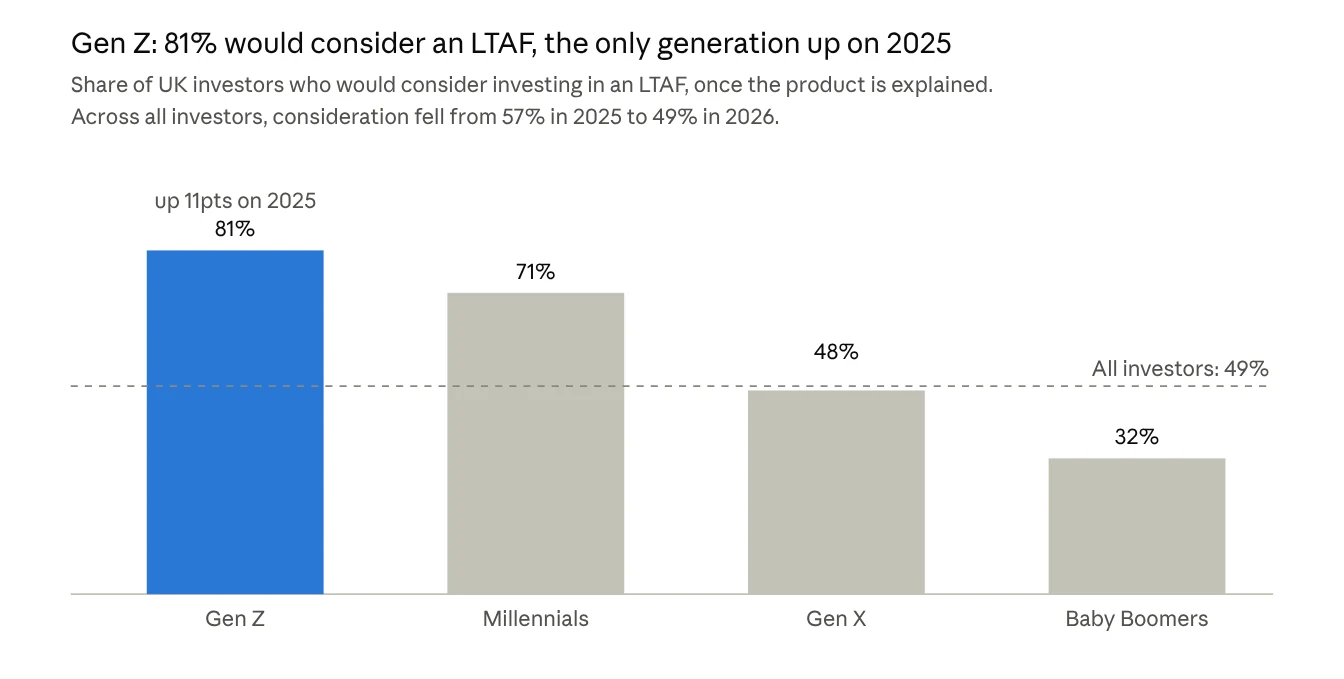
One caveat before anyone builds a thesis on these numbers: they measure willingness to consider, not money invested. The IA reads the pattern as a pool of future demand among younger, longer-horizon investors once they know the product exists, which is different from saying Gen Z is driving current LTAF inflows.
Who is investing today
The capital behind that £7.3bn comes mainly from established channels. Institutional investors and DC workplace pensions are the most developed, with allocations decided by trustees, governance committees and investment professionals rather than individual savers. Private banks, family offices and high- and ultra-high-net-worth clients form the second channel, often investing through international structures. The advised mass-affluent market, the segment democratisation is supposed to reach, remains far more limited: minimum investment thresholds, enhanced suitability assessments and bespoke onboarding have yet to reach scale.
The groups also think about the asset class differently. Institutions allocate by asset class as part of strategic portfolio construction. Wealth clients are outcome-driven, weighing investments against retirement planning, income, preserving capital and passing wealth on. Most wealth managers told the IA that clients rarely seek private markets proactively; exposure is adviser-led, and suitability matters more than whether someone counts as retail, sophisticated or high-net-worth.
The report does not break the £7.3bn down by investor type, so none of it should be read as a measure of retail money.
What the money is buying
Private markets span four main asset classes: private equity, private credit, real estate and infrastructure. The report does not rank them by retail demand, and the clearest pattern sits on the pensions side. Where DC schemes have made progress, several found real estate and infrastructure, including social housing and assisted living, more straightforward to implement than private equity or private credit. That is partly operational, and partly because those assets give schemes a tangible UK story to tell members.
In private wealth, allocations stay modest. Private market holdings typically sit inside existing asset-class buckets, with private equity treated as part of the equity allocation and private credit assessed alongside higher-yield bonds. Most wealth managers expect exposures to remain around 5% of portfolios, potentially moving towards 10% in some segments over time. Those are reported expectations about typical portfolios, not a recommendation for any individual investor, and the binding constraint is less willingness than implementation: illiquid and semi-liquid funds are hard to run inside model portfolios built on daily prices.
Why interest isn't becoming adoption
Three gaps in the report separate stated interest from money actually moving.
The first is awareness, covered above: a product only 5% of investors say they fully understand does not get bought at scale without someone explaining it.
Distribution is the second. UK platforms and model portfolios were built around daily-dealt funds. LTAFs deal infrequently, quarterly in most cases, with redemptions no more often than monthly; they require at least 90 days' notice for redemptions, and typically cap redemptions at around 5% of net asset value per quarter. Those terms sit badly in systems that assume daily prices, and the IA's stakeholders described a "chicken and egg" dynamic: platforms wait for proof of demand before building, while managers and advisers wait for infrastructure before distributing. There is movement. Hargreaves Lansdown added two Schroders Capital LTAFs (global private equity and energy-transition infrastructure) in September 2025, becoming the first platform to offer LTAFs inside a SIPP, and LTAFs became eligible for stocks and shares ISAs in April 2026. Morningstar counted 25 LTAF strategies on sale in the UK this April, most of them private multi-asset or private debt.
The third gap is confidence. Advisers want consistent data, clear fees and suitability assessments they can defend, and some worry about professional indemnity cover for unfamiliar products. SIPP capital rules still class LTAFs as non-standard assets, which makes them costlier for operators to offer. Eligibility rules add their own brake: unadvised investors classed as restricted investors must confirm they have put no more than 10% of their net assets into restricted mass market investments such as LTAFs, after a personalised risk warning and an appropriateness assessment.
None of that is solved by launching more funds. The IA's own conclusion is that the next phase depends on distribution infrastructure and investor understanding catching up with product development, and on that measure the gap between the 81% of Gen Z who would consider an LTAF and the 5% of investors who know what one is remains the most honest summary of where UK private markets democratisation stands.
The private markets series
- •1. Private markets are opening up to retail investors. Who's buying what? (this article)
- •2. £7.3bn in LTAFs, but retail adoption remains a work in progress
- •3. FCA plans 90-day notice period for illiquid funds: what investors need to know
- •4. Private equity's 19.2-point return gap puts manager selection in focus
- •5. Private markets fund managers plan to raise personal allocations from 12% to 18%
- •6. Investment trusts and alternative investments: why the traditional route is under pressure
Sources
- •Investment Association, Private Markets Democratisation in the UK: Promise, Progress and Key Next Steps, October 2026 (primary source; figures from pp. 4 and 11–17; published at theia.org). The IA is the trade body for UK investment managers, so its research reflects an industry perspective.
- •FCA, PS23/7: Broadening retail access to the long-term asset fund, 29 June 2023
- •Pensions Age, "Institutional and wealth sector investment drives LTAF AUM up to £7.3bn", 7 April 2026 (Morningstar's April analysis of the same LTAF figures)
- •Markets Media, "Schroders, Hargreaves Lansdown Offer Private Funds to Retail", 8 September 2025
- •Alternative Credit Investor, "LTAFs gain ground as retail access to private markets widens", 7 April 2026
- •Morningstar, "What Is a Long-Term Asset Fund?", updated 2025
Disclaimer: Nothing here is investment advice. LTAFs are illiquid products with notice periods and redemption limits; whether they suit any portfolio depends on individual circumstances.
Weekly newsletter
The UK alternative investment market, weekly.
New listings, FCA status changes, and market moves — every week.