

Introduction to Private Real Estate
Real estate represents one of the oldest and most intuitive alternative investments. Beyond the familiarity of bricks and mortar, private real estate offers income generation, capital appreciation, and inflation hedging that has attracted investors for centuries.
Only around 7% of commercial real estate in Europe is held by publicly listed companies, meaning over 93% of the market — worth more than €7 trillion — is accessible only through private markets. Globally, private real estate funds raised approximately $154 billion in 2019, and institutional allocations have remained strong through 2025.
Over 25 years, private real estate has delivered average annual returns of approximately 9.9%, though with considerable variation by strategy, geography, and market cycle. For UK investors, the asset class is increasingly accessible through crowdfunding platforms, REITs, and fund structures — with minimums starting from as little as £100.
Understanding the landscape helps identify opportunities aligned with your goals and risk tolerance, and a trusted, high-quality provider is essential for navigating this complex asset class.

Real Estate Investing Across the Capital Stack
Real estate investing can take many forms, spanning different types of debt as well as equity. Each differs substantially in risk-reward profile and investment horizon.
Private Real Estate Debt
Real estate private debt refers to loans made to developers or investors, secured against property. Investors provide capital and receive regular interest payments. These loans include:
- **Mortgage / Investment Loans**: Longer-term financing of income-producing assets
- **Construction Finance**: One or more layers of debt funding new-build projects
- **Bridge Finance**: Short-term capital bridging stages of a project — from acquisition to construction, completion to sale, or during refurbishment
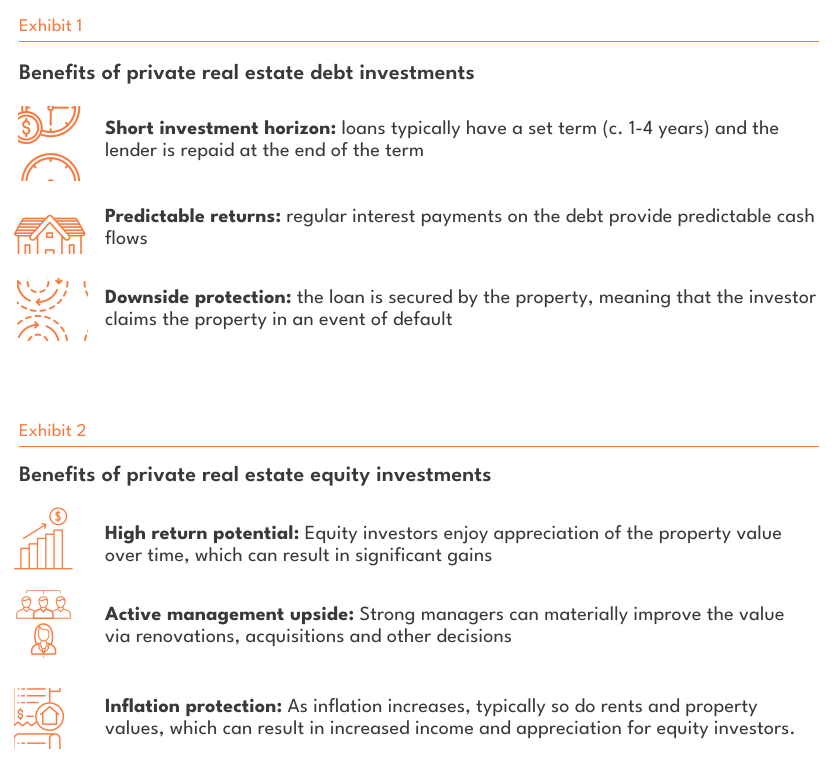
In the event of default, the lender can typically seize the underlying property. Seniority within the capital stack determines risk: senior debt has first claim and lowest risk; mezzanine debt is subordinated with higher yields; preferred equity is a hybrid offering a preferred return before common equity holders.
Private Real Estate Equity
Equity investors become part-owners of property and share in both income and appreciation. This typically involves a longer hold period than debt, as investors benefit from cash flow and value growth over time.
| | Key Characteristics | |---|---| | Debt | Short horizon (1–4 years), predictable interest income, downside protection via property security | | Equity | Higher return potential, active management upside, natural inflation protection as rents and values rise |
Overall, debt provides a more conservative option for investors seeking regular income, while equity offers higher potential returns for those willing to accept greater risk.
Property Types and Sectors
Residential
Buy-to-Let (BTL): Direct ownership of rental properties. The traditional route, though UK regulatory and tax changes have significantly reduced its attractiveness. A minimum 25% deposit and specific BTL mortgage are required, with lenders needing rental income to exceed mortgage payments by 25–30%.
Build-to-Rent (BTR): Purpose-built rental developments, increasingly institutionalised with professional management and scale economics.
Student Housing (PBSA): Purpose-built student accommodation with defensive characteristics and predictable academic-year demand.
Commercial
Office: CBD and suburban offices, facing structural shifts from hybrid working but benefiting from flight-to-quality trends.
Retail: High street, shopping centres, retail parks. Significant e-commerce disruption, though convenience and experiential retail remain resilient.
Industrial / Logistics: Warehouses, distribution centres, last-mile delivery. Strong tailwinds from e-commerce growth — one of the best-performing sectors of 2020–2025.
Alternative Sectors
Healthcare: Care homes, medical offices, life sciences. Ageing demographics provide structural demand.
Data Centres: Critical digital infrastructure with high barriers to entry and long-term contracts.
Self-Storage: Resilient through cycles with relatively low capital intensity.
Each sector offers different risk-return profiles, income characteristics, and sensitivity to economic cycles.

Investment Strategies
Core Stabilised, income-producing properties in prime locations. Low leverage (0–30%), steady returns (6–9%), and minimal development risk. The bond-like option within real estate.
Core-Plus Similar to core with light value-add opportunities — lease restructuring, minor refurbishment, improving tenant mix. Moderate leverage (30–50%), returns of 9–12%.
Value-Add Properties requiring significant repositioning — major renovation, re-leasing, development completion. Higher leverage (50–70%), target returns of 12–18%. Requires active management and carries execution risk.
Opportunistic Ground-up development, distressed acquisitions, complex turnarounds. Highest leverage and risk, targeting 18%+ returns. Substantial execution and market timing risk.
A Note on Risk-Return and Leverage
The level of leverage — how much debt is taken against an asset relative to its market value — is a fundamental indicator of risk in real estate. A senior loan might cover 50–60% of value, while mezzanine debt extends to 70–80%. Understanding your position in the capital stack, and the downside protection it affords, is critical to evaluating any real estate opportunity.
An investor with a first charge on a property should not expect the same returns as a mezzanine investor with a second charge — and equity investors, with no downside protection, should command the highest expected returns.
How to Access Private Real Estate
Buy-to-Let (Direct Ownership)
The most traditional strategy: purchasing property and renting it out using a BTL mortgage. After years of significant activity, fewer UK investors are pursuing this route due to changes in stamp duty and tax relief, plus the time-consuming demands of tenant management and property maintenance.
Private Real Estate Debt Platforms
Many investors have turned to private real estate debt as an alternative to BTL. An asset manager or developer needs capital — for example, to purchase and develop a property — and the investment platform provides a secured loan, which is then syndicated to retail investors.
The platform's investment team structures appropriate terms including interest rate, loan-to-value, term, and security arrangements. High-quality platforms often invest their own capital alongside investors ("skin in the game"), which can be a positive signal.
Platforms earn fees through origination charges to developers (typically 1–2%) and a spread on the interest rate passed to investors.
Fractionalized Equity Platforms
Emerging models allow fractional ownership of property. The platform purchases equity and sells smaller portions to investors, who then share in appreciation and rental income. Annual management fees are typically around 1%.
REITs
Real Estate Investment Trusts offer daily liquidity via the stock exchange, professional management, diversified portfolios, and a tax-efficient structure requiring 90% income distribution. Both UK-focused and global options are available.
Private Real Estate Funds
Open and closed-end funds offer diversification and professional management with minimums from £10,000+, though with limited liquidity (monthly/quarterly redemptions).
Even more so than with debt, the quality of the underlying asset is critically important for equity investors. Without the downside protection of a secured loan, choosing a reputable provider with genuine real estate expertise is essential.
UK Market Considerations
Buy-to-Let Tax Changes
The UK has significantly reduced BTL tax advantages:
Mortgage Interest Relief: Fully phased out for individual landlords. Interest costs now receive only basic rate (20%) tax credit, regardless of marginal rate.
Stamp Duty Surcharge: Additional 5% SDLT on second properties over £125,000 (from April 2025).
Capital Gains Tax: Current rate of 18–24% on residential property gains, with £3,000 annual exemption.
Section 24: Full implementation means higher-rate taxpayers may face effective tax rates exceeding rental income — a key driver of the shift toward platform-based alternatives.
Regional Variations
- **London**: Lower yields (3–4%) but capital growth potential
- **Northern Cities**: Higher yields (6–8%) with regeneration stories
- **University Towns**: Stable HMO and student housing demand
UK Platform Landscape
UK property platforms include: - Kuflink: Property-backed lending from £100 - CrowdProperty: Development lending from £500 - CapitalRise: Prime London bridge lending from £1,000 - British Pearl: Residential equity investments
UK REITs
Liquid, diversified exposure via the stock exchange: - British Land: Prime London office and retail - Land Securities: Mixed UK commercial portfolio - SEGRO: Industrial and logistics focus - Unite Students: Purpose-built student accommodation - Primary Health Properties: Healthcare facilities
Understanding Real Estate Returns
Income Return
The yield from rental income after operating expenses:
Net Operating Income (NOI) = Gross Rental Income − Operating Expenses
Cap Rate = NOI / Property Value
A property generating £100,000 NOI valued at £1.5 million has a 6.7% cap rate.
Capital Return
Appreciation (or depreciation) in property value, driven by rental growth, cap rate compression or expansion, physical improvements, and market cycles.
Total Return
Combined income and capital returns. UK private real estate has delivered approximately 9.9% average annual total return (2000–2024), with 5–6% from income and 2–4% from capital growth.
Risk Considerations
Interest Rate Sensitivity: Property values are inversely related to rates. The 2022–2023 rate rises caused significant declines, particularly in lower-yielding sectors.
Valuation Smoothing: Real estate valuations are appraisal-based, understating true volatility. Transaction prices during stress periods often exceed appraisal-implied declines.
Maximum Drawdown: The 2007–2009 GFC saw UK commercial values decline 40%+. The 2022–2023 rate shock caused 20–25% declines in certain sectors.
Is Real Estate Right for You?
The Case For
- **Tangible asset**: Unlike equities or bonds, real estate is a physical asset you can understand intuitively
- **Income generation**: Rental yields provide regular cash flow, particularly attractive in low-rate environments
- **Inflation hedge**: Rents and property values tend to rise with inflation over time
- **Diversification**: Low correlation with public equities and bonds
- **Tax advantages**: REITs offer efficient structures, and platforms can provide ISA-eligible options
The Risks
- **Illiquidity**: Private real estate cannot be quickly sold without price impact. Forced sales during stress crystallise losses
- **Leverage**: Debt amplifies returns in both directions. Over-leveraged properties face foreclosure risk in downturns
- **Concentration**: Single properties concentrate risk — diversification across geographies, sectors, and managers is essential
- **Platform risk**: Crowdfunding platforms may face operational difficulties. Consider platform financial strength and regulatory status (FCA authorisation)
- **Obsolescence**: Buildings require ongoing capex. Environmental regulations (minimum EPC requirements) increasingly impact lettability and value
Suggested Allocation
Real estate typically represents 5–15% of diversified portfolios. Balance direct and indirect exposure based on your capital, expertise, and liquidity needs. For most retail investors, a combination of REITs for liquidity and platform-based debt or equity for yield enhancement offers a practical starting point.
The quality of the underlying asset — and the provider managing it — is the single most important factor in real estate investing. Always ensure you understand the security position of your investment and what happens in the event of default.